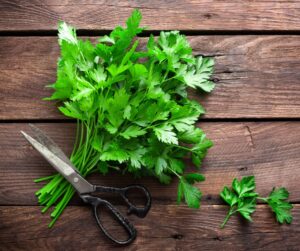
9 Parsley superstitions – and that’s probably not all of them! – because this innocuous looking herb has one of the longest lists of superstitions attached to it of any plant.
Admittedly, the fact that this blog is first posted the day after Friday 13th has something to do with my choice of topic. But as parsley is one of the most popular culinary herbs its rather fascinating to know a bit more about it, don’t you think?
Parsley – a bit of botany
Parsley, Petroselinum crispum, curly leaved parsley, is a member of the Apiaceae or Umbelliferae family. Like most of the other members, it has aromatic foliage and hollow stems.
Also known as rock celery, because of its edible tap root, this root provided the source for the name Petroselinum. Which came originally from the Greek, petra – rock and selinon – celery. There is a variety, Hamburg root parsley, which was bred to have a more pronounced edible root.
Petroselinum are biennial plants, so in the first year they produce their foliage and in their second, of small white / pale green flowers will appear. As we grow parsley mainly for its aromatic leaves, there is a tendency to forget about the flowers and seeds, both of which are also edible. You could allow one plant to flower and seed and then collect the seed to sow and grow more parsley. (see blog link below)
Parsley is native to Algeria, Greece, Morocco, Yugoslavia, and has become widely cultivated in much of Europe and the Americas over the last 5000 years. Indeed it is one of the most popular of herbs grown in homes and gardens.
When did we start growing parsley in our gardens?
The Romans possibly brought it to Britain, but there are records of curly leaved parsley and also Alexanders (horse parsley, Smyrnium olusatrum) being grown from Anglo Saxon times for medicinal purposes, particularly in monastic physic gardens.
As for use as an edible plant, parsley gets a mention in ‘Forme of Cury’ Richard II’s cookery book (written c.1390) but we cannot be sure whether the parsley mentioned was curly leaved parsley or Alexanders. And just because it’s an ingredient it doesn’t mean that the parsley was also being grown in an English garden as a culinary plant. (Do you grow your own cinnamon?) Although equally, it doesn’t disprove the cultivation of parsley either.
The first definite mention of cultivation in British gardens is in 1548. But interestingly, it’s also stated that parsley had become naturalised in rocks and old walls during the 16th century. Which to my mind is pretty speedy if it was only introduced mid-century. Unless of course, it was Alexanders which had naturalised, earning itself the other common name of wild parsley. however, whilst such plant history is fascinating, its not what we’re here for in this blog, so let’s move onto the superstitious stories…

Parsley Superstitions #1
We’re starting with positive one from ancient Greece, where parsley was worn as a wreath for the victors at the Isthmian and Nemean Games (part of the Olympic game cycle) as it was considered a good luck charm. for the same, reason, legend says Hercules wore a parsley wreath in his battle with the hydra.
Parsley Superstitions #2
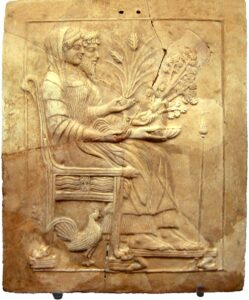
Still with Greece, parsley wreaths were also laid on graves and parsley was one of the herbs used to reduce the corpse smell (which could very quickly become an issue in warmer climes). This led to an association of the herb with death and dying. The picture is of Hades and Persephone, where she may be holding a symbolic bunch of parsley.
Parsley Superstitions #3
Another superstition is that parsley is the devil’s herb because the seed has to go to the devil and back nine times before it will germinate. although this could well have come about because parsley seed does take a much longer tome to germinate than other herbs – up top 6 weeks.
One way to get around this is to soak the seeds overnight in warm water before sowing (but it still won’t be quick!)
Parsley Superstitions #4
Once we get to Christian times and countries, we find ways of getting around the devilish intervention. Parsley seed should only be sown on Good Friday, preferably at 3pm. (The time of the Crucifixion). I wonder whether allowance was made for the fact that Good Friday is one of those moveable feasts and could be anytime between late March and mid-April?
And Another Superstitions #5
But the superstitions get more complicated than that.. Only a woman should sow parsley and for the best results it should be when church bells are ringing. Which is maybe a way round the best time to sow the seed, as parsley can be sown from the beginning of March through to late August. Doing this will give you a good succession of the herb to harvest.

Parsley Superstitions #6
If a man should dare to sow parsley it won’t germinate at all. Two reasons are suggested for this. Firstly, the devil is still in the parsley bed. Or secondly, that “where Missus is Master parsley won’t grow”.
Parsley Superstitions #7
Assuming you manage to get your parsley to germinate and it grows well be advised – do not transplant it! why? Because it is a precursor to a sickness, death or disaster in the family.
(Should working in a plant nursery carry this as health warning I wonder?)
Parsley Superstitions #8
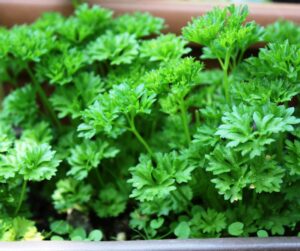
Scenario – a visitor admires your bed of thriving parsley and asks for a plant to take home as there’s didn’t germinate (and we know why, don’t we!). Do not give them a plant – this is also asking for trouble as it means you are giving away the good luck your parsley has brought you so far. Or even worse, that when you give someone the gift of parsley from your garden you’re sending them to their death.
What should you do? Possibly hum and haw a bit about not really being superstitious but would they mind nicking a plant or two when you’re not looking instead? It seems that stealing a parsley plant, openly like this or even without the owner realising is the only safe way.
Parsley Superstitions #9
Not that I’m endorsing binge drinking, but the Greeks believed that wearing a parsley wreath at a feast would prevent a hangover. If you think people might notice, try chewing parsley seeds instead as they have been known to help in reducing headaches. (NB I’m not promoting this as a cure!)
and an extra superstation, just because
Parsley will only grow outside the home of an honest man or a strong woman.
Perhaps that’s why it’s always done well in my old garden and the allotment 😉 Although possibly following my Mother’s and Grandfather’s tips for propagation and cultivation helped too.

And finally
Just as some of the parsley superstitions are contradictory, so too are some of the numerology superstitions surrounding the number 9. Whilst some consider its placement as the highest single digit to be auspicious, others take the opposite view. In Chinese the number nine sounds similar to the word for longevity and is their second luckiest number. But in Japanese, the word for nine sounds similar to the word for suffering and so is considered unlucky.
But back to parsley and gardening related matters. If you would like help with designing a herb garden or learning how to grow a range of herbs do get in touch. We offer both planting designs and 1-2-1 gardening courses to support you and improve your garden.
For further gardening advice and inspiration, check out Plews Potting Shed blogs, including the selection below and our monthly Tipsheet – You could come and find us on Instagram Pinterest and Facebook too.
Related Gardening articles you may enjoy from our Award Winning Blog
Herbs, including Parsley , in Your Garden
Parsley Sage Rosemary and Thyme
3 Herbs to Overwinter in your Garden to use in your Kitchen
Getting Going with Growing – National Gardening Week 2017
Collecting Seeds from Your Garden
Planting Design, Garden Design – Herb Gardens
Inspiration for a Courtyard Herb Garden
What is an Ornamental Edible Garden?
The Herbal Bed – Stage Set Design
Hardwick Hall Herb Garden – Garden Visit
Plews Services – Herbs and more
Should You use a Garden Designer?
What Might a Plews Gardening Lesson Be Like?
click here for more information on Plews Gardening Lessons and Courses to download