The current design of Hardwick Hall herb garden is not the original sixteenth century one. In the 1970s the National Trust commissioned Paul Miles to create a new herb garden. Garden writer Val Bourne considered it one of the most impressive herb gardens in England (writing in 2000). This layout was updated in 2004 by Isabelle van Groeningen to the structure you see now. Set in the rolling hills of Derbyshire and watched over by Bess of Hardwick’s Tudor mansion, she might not recognise the layout, but she’d certainly recognise some of the herbs.
I do love herb gardens, and this one is no exception: I love it. Surrounded by tall hedges and forming one of the garden ‘rooms’ or courts that make up Hardwick Hall Gardens it has a different feel to the other areas.
Let us begin with a query: would you consider Lily of the Valley to be a herb? Although not a good idea to eat this herb, it does play a role in medicine, being used for heart problems, for example. Hardwick Hall have their own variety, which has a pretty pale pink flower rather than the more usual white. Lily of the valley grows well in woodland and shadier spots in your garden.

Sulphur Lavender isn’t a lavender at all. It’s Santolina rosmarinifolia sub species canescens! You’ll find both Santolina chamaecyparissus, known as Cotton Lavender and Sulphur Lavender in Hardwick Hall herb garden. Evergreen, with aromatic foliage they make decorative small shrubs for your garden. Cotton lavender has silver grey foliage and yellow flowers; Sulphur lavender’s flowers are paler. The latter doesn’t have any known medicinal uses, but Cotton lavender leaves may be used as a disinfectant.

Hardwick Hall Herb Garden – Culinary Herbs
There are culinary herbs aplenty! Chervil, Anthriscus cerfolium, has a more delicate flavour than Parsley. In looks, it resembles Coriander, having a similar foliage, although the plant is smaller.

Caraway, Carum carvi, is a member of the carrot family. Caraway seeds are used in cooking and sometimes added to drinks. For example, the crushed seeds add an interesting piquancy to black coffee.
Both caraway and chervil are biennial plants, growing a basal clump of leaves in their first year; then flowering in their second year, producing seeds and then dying.

By contrast, tall Angelica archangelica adds architectural stance to a herb garden or any flower border. Another biennial, the large globe like flower heads stand proud, only slowly drooping as flowers turn to seeds and the summer edges slowly but surely towards autumn.

Growing Herbs in a Herb Garden
The term ‘herbs’ is a wide one, encompassing plants we can eat, plants to make us better when we’re ill and plants we use to beautify ourselves or soothe aching muscles. Many larger herb gardens sub-divide their herb plants by use, or by geographical origin. In our domestic gardens, we might prefer to be less formal, growing sun loving Mediterranean herbs together. Or perhaps putting together a trough of annual herbs in a sunny spot that’s convenient for the kitchen.
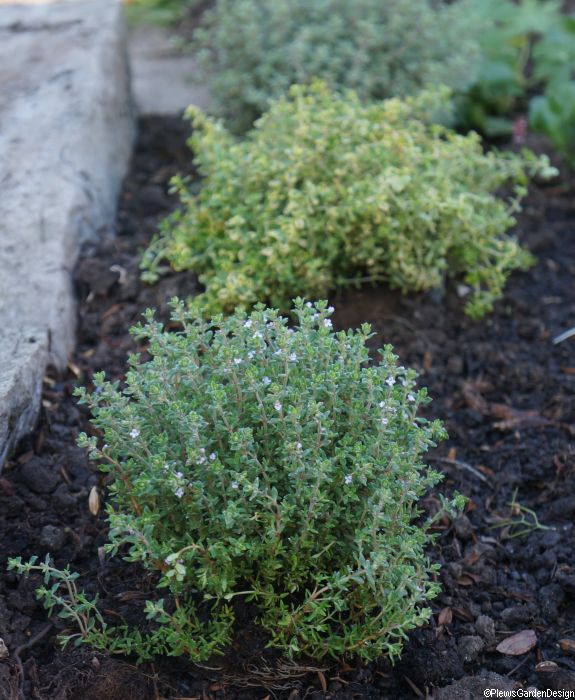
Whether you garden on heavy clay or a light sandy soil, your herbs may benefit from being grown in slightly raised beds. Growth can be contained within the beds for a formal, neat look, or allowed to spill over onto paths, as here.

Herbs are often grown in kitchen gardens, and the reverse can be true. Certainly, in Hardwick Hall herb garden you’ll find peas and cucumbers growing. These flowering vegetables benefit from the pollinating insects who are attracted by the scented herb flowers. The supporting framework is made from hazel twigs which have been grown for this use elsewhere in the garden.

The Changing Face of Hardwick Hall Herb Garden
And just to prove that gardens change over the course of the year and over the years, here are comparison photographs. Taken about three years apart in the same place in Hardwick Hall Herb Garden, the first, earlier one in August, the second one is in June.
Things to note: –
- Trees grow and can block out a view – which is both a good and a bad thing. Be prepared to prune, choose a slim fastigiate shape or choose a smaller tree if you want to retain some of your view.
- The santolina balls have been clipped to shape, but some have been replaced. If formality is your goal, then regular use of shears will be essential to maintain the look.


Hardwick Hall is situated in Derbyshire and managed by the National Trust.
For more inspiration, check out the links below. And if you would like a herb garden designed, be it large or small, a permanent feature or as a temporary display, please get in touch with us.
Related Gardening articles you may enjoy from our Award Winning Blog
Garden Visits –
Hardwick Hall Gardens
Iden Croft Herbs, Mint, National Plant Collection
Downderry Nursery – National Lavender Collection
Herbs and Herb Gardens
Thyme for a Herb Garden
Inspiration for a Courtyard Herb Garden
Herbs for Summer Salads
Getting Going with Growing – National Gardening Week 2017 – it’s all about Herbs and how to start your own herb garden