

Winter gardening tips for plants to help you to keep them warm over the cold season whether the plants are in your garden borders, pots or in your greenhouse.
Meteorological winter runs from 1st December to the 31st of March, for the purposes of record keeping and comparisons between years. But for us gardeners, depending where we live: in the town or in the country; near the warming effects of the Gulf stream or in the path of strong easterly winds from the North Sea, is what counts.
For those of you who know your garden fairly well, these are reminders to save you forgetting crucial tasks. And you’ll have your own to add related to your particulars gardening needs.
Those of you who are new gardeners should find this a helpful checklist and starting point.
And for those gardeners who have moved to a new garden since spring this year, it’s a ‘nudge’ that different gardens in a new location may have a whole new list of winter requirements. As for me, in the winter of 2022-23, I’m in this last group, with a much larger and seriously overgrown garden in need of renovation which presents its own challenges. But more of that in other blogs and the book to come where you can laugh at our escapades and learn from my mistakes.
Talking of other blogs, there are links at the end with more information and ideas relating to each of the tips here.
Winter Gardening Tips for Plants – Frost Proofing
Specifically the plants you have in pots in the garden. The roots of all trees, shrubs, small perennials and even bulbs in pots are at risk of being frozen when the temperature drops and stays below freezing as they are more exposed. Conifers and evergreens are in some ways more at risk as they are still growing, if slowly, over the winter.
- Lift the pot or tub off the ground with bricks or pot feet, to prevent waterlogging. It’s also a good idea where pots are sitting on cold winter concrete.
- I’ve raised decking planks one brick high and placed rows of pots on these. This can look quite decorative against a wall.
- Place pots and tubs together in a sheltered area of the garden. This helps to create a micro climate and reduce the frost damage.
Wrapping the pots
Use hessian, fleece, bubble wrap or old towels around the sides of the plant pot, tying in place if needed. This is especially important for those borderline plants and those in more exposed places. You can make a feature of a necessity. For example, pots wrapped in hessian with Christmas decorations pinned on look suitably festive!
- You can use hessian or horticultural fleece to cover the soil and lower stem of your tree or shrub as these will allow water and air to pass through.
- Mulching the soil is another option.
The bases of the pots don’t generally need to be covered. If you feel it is needed, use a permeable insulator such as hessian or fleece.

Even more protection
I give importance to the roots as this is what keeps perennial plants going from year to year. Sometimes, though, we may want or need to give the top growth frost protection. For example, if our lemon tree is now too big to fit into the porch or greenhouse. As well as protecting the pots as above, you need to wrap the branches.
For ease, those fleece covers you can buy and put over the plant are usually enough, and you can always double them up. Hessian and fleece can also be wrapped around. Blankets are useful for dormant plants, just check after rain that there’s no stem breakages as the blanket can get heavy when wet.
NB: Where you have covered over the top of a plant and it’s still growing, such as an evergreen, remember that it will need light getting to its leaves so as to photosynthesise.

Plants in the Ground
Mulch!
Because their roots are protected these plants are generally at less risk. The important thing is to keep the frost away from the exposed soil surface.
However, young plants that have gone in this year will be more susceptible to the temperature drop, just as they were to the high temperatures this summer. If you haven’t cut them back, perhaps as they had seedheads that you ‘d left for the birds, then I would suggest not cutting back until early spring. Those stems will provide some protection for any new growth coming through from the base. See pruning tips below if you do need or want to cut back.
Gardening Teacher Tip
You may have plants in small pots, 2 litre sized or less, that you’re not sure what to do with as they are : –
- plants that you were going to put into bigger, decorative pots but you haven’t found the right pot yet
- potted plants that are still waiting to be planted into the borders – perhaps because
- you haven’t had the time to do it yet
- the soil in the borders needs improving first
these solutions may help!
If you have spare larger pots – which can be plain rather than decorative – put the smaller pots in these and fill the gap between the two with mulch or even scrunched up newspaper (this may need replacing / adding to if it gets very wet and rots down). Then treat as in the section above for wrapping.
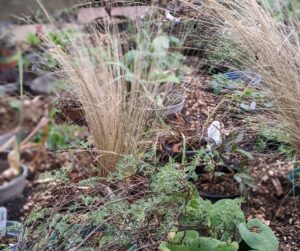
Plant the pots. Either in the border which isn’t ready yet or anywhere there is space. This is a temporary fix to give the plant roots extra protection over winter so don’t worry too much about the soil condition. I’ve had to take this option and a couple of the borders have such heavy clay soil I could make pots with it! I dug slightly bigger / deeper holes than were needed and threw in some gravel, wood chippings and used potting compost from growing veggies.
If you can only get the pots dug in part way, don’t worry, top up the level with a mulch – be creative, think fresh and rotted wood chippings, leaves, shredded cardboard.
Add a mulch layer over the top of it all.
Winter Gardening Tips for Plants in Greenhouses and Polytunnels
Firstly, making your greenhouse or polytunnel ready for winter.
Reducing wind damage from winter storms
There are a number of easy things that can be done to minimize the chances of damage. Two quick and easy checks are: –
- close the windows, vents and door
- remove or put away clay pots and so on that could be blown against the greenhouse and break the glass or rip plastic
Also where you have glazing, take time to review it. What type of glass is currently in use? If it is still horticultural glass then consider replacing this with safety glass. Clear styrene can be an economical alternative if there are budget restrictions. The last thing you need is a garden filled with shards of glass!
For polytunnels and plastic greenhouses, check for splits in the fabric and tape up any you find. Even small splits may be an issue if left to get worse.

Photo by Annie Spratt on Unsplash
Catching the most of the winter sunlight is particularly important when you have tender evergreen perennials that are still growing during this season. Citrus trees, tender Lavenders, Aeonium are some of mine.
To maximise the light reaching your overwintering plants, you need clean greenhouse panels. Marks and dirt on the panels reduce the amount of light available for your plants.
This is true whether you have glass or plastic greenhouse panels.
In an ideal world, you’d be able to clean the panels in the autumn and they’d stay clean all winter. But with storms, falling leaves and pigeons to contend with, the odds are that you need to clean the greenhouse panels at least once during winter.
Soap, water and a long-handled sponge for windows make this a quick task, even for the exterior roof panels. Quick and easy is always good!

Winter Gardening Tips for Plants – Cheap ways to warm and insulate your Greenhouse and Polytunnel
These may be some of the critical winter gardening tips given the price of heating!
But did you know that the average interior temperature of an unheated and uninsulated structure will be 2-3 degrees higher than it is outside? Good insulation can raise that to 4-5 degrees higher inside – and that’s before any heating is added.
If you have a heated greenhouse or polytunnel, adding insulation will reduce the heating requirements, thereby reducing the cost.
It may sound obvious, but before insulating, do these things: –
- Check that opening windows and doors close fully and there are no gaps. If ventilators need to be opened during the day, open them once the morning chill has gone over, and close well before the sun dips low and has no heat left.
- Discover where the cold spots are – possibly in the corners. Have this in mind when organising which plants go where, as well as possibly increasing the insulation in those spots.
Line your greenhouse or polytunnel with bubble-wrap or horticultural fleece. For the greatest benefit, leave a gap between the panels and the insulation.
Budget option – use cardboard in the lower sections – a good way to recycle all that packaging. It does reduce light so not an option for the whole structure unless all the plants are dormant.
Use heat sinks. This is where we make use of free heat. Stone floors that are in the sun will radiate that heat back in to the greenhouse or polytunnel overnight. Water also works as a radiator and is more effective than stone. If there’s not room for a water butt inside, you could use a bucket.
Line gravel trays with newspaper, cardboard or capillary matting, stand pots on this as it provides better insulation than standing them directly on the floor.
Wrap pots and cover plants as in the sections above.
Gardening Teacher Tip
As the pots are inside, using cardboard, newspaper and hessian is a better option than fleece or bubblewrap as they are breathable materials. This helps to reduce condensation, which can be a real issue in polytunnels and plastic greenhouses.

Winter Gardening Tips for Plants – Pruning
This is a big topic, so I will point you in the direction of the relevant blog (link below) for lots of info and tips. What I will ask here is do you know –
- what trees and shrubs to prune?
- and just as importantly, what trees and shrubs not to prune?
Regarding trees, larger shrubs and hedges you also need to ask yourself and check if you’re not sure: –
- Is there a Tree Preservation Order?
- Do I live in a Conservation Area or National Park?
- Is a tree surgeon needed ?
And a reminder that it is inadvisable to prune
- when there is a heavy frost,
- or late in the day when a frost is forecast.
This is because the pruning cut is an open wound and the frost may damage the tree or shrub until it has healed over.

Winter Gardening Tips for Plants – Edible Gardens, Vegetable Plots
Another precis of tasks for the winter kitchen garden, be it large or small. Some of these jobs will take you longer than others, others may need repeating. And some you can do in the warm with a cup of coffee (always useful on particularly cold days!)
For the detailed tips and ideas, check out the full blog in the links below.
- Harvesting winter vegetables, stored vegetables
- Tidy up the vegetable plot
- Ordering and sorting seeds, tubers
- Forcing rhubarb
- Tidying sheds and cupboards
- Preparation of new perennial beds
- Creation and / or purchase of compost bins, water butts
- Inspecting sheds, greenhouses, etc
- Planning for next year
And finally…
I feel we’ve barely scraped the surface with these winter gardening tips for plants. It’s certainly made me feel I should put down my pen, turn off my PC (yes I use both) pull on boots and a warm coat and head outside!
For those of you who like Christmas – why not download our eBook “Christmas and Yule in Your Garden“?
We’re always adding to our freebie gardening printables for you to download too. These include plant lists to inspire you, planners to help with your gardening tasks.
Or if you’re looking for a Christmas gift with a difference, why not ask about Plews’ bespoke Gardening Lessons, where your classroom is actually your own garden? I can help you with both gardening basics and more ‘expert tasks’, carry out worm and other experiments and for example, also show you how to plan a wildlife friendly ornamental border.
For further gardening advice and inspiration, check out Plews Potting Shed blogs, including the winter gardening tips and ideas selection below and our monthly Tipsheet – You could come and find us on Instagram Pinterest and Facebook too.
Related Gardening articles you may enjoy from our Award Winning Blog
Winter Gardening Tips For Plants
Vegetable Gardening Tasks for Winter
Your Greenhouse Plants Winter Checklist
Making your Greenhouse ready for Winter
Planting Ideas for Winter Gardens
Growing Mistletoe for Christmas and for Wildlife
Scented Shrubs for Christmas Morning
Tall Trees and Woodland Gardens
How to create a Woodland Edge Habitat in Your Garden
Chimonanthus praecox – Wintersweet
12 Design Ideas for Your Winter Garden
Winter Gardening Related Facts and Fun
Holly, Yerba Mate, Coffee – What’s Growing in Your Garden?
The Winter Solstice and Your Garden
Could You Grow Your Own Christmas Pudding?
Interesting Plant Facts – Gold Frankincense Myrrh
Trees and Shrubs
How to Choose a Tree for Your Garden
Coppiced Trees and Shrubs in Your Garden
Trees in the Garden – Questions and Answers
And Winter Flash Fiction

One of my borders with pots sunk into the borders and mulch applied.
I ran out of mulch to fully protect the pots so had to wait for the tree surgeons visit to add more!


