
Why a blog entitled “Could You Grow Your Own Christmas Pudding”?
Well, I thought, if you like growing some of your own food, why not explore the possibility? If nothing else, it may increase your awareness of the range of food that you could grow, with and without the protection of a greenhouse or polytunnel. And that’s certainly a mindset I like to encourage with my gardening lesson clients. And not just in the Edible Gardening lessons either!
What sparked this idea was the arrival of Stir-up Sunday at the end of November. This is the traditional day to make your Christmas pudding, roughly one month before Christmas. Many people, myself included, have family recipes and favourite recipes.
But did you know that the original source for this dish dates back to the Middle Ages and a plum pottage? A pottage is a thick, soupy dish containing variously meat, vegetables, fruit and herbs.
From the 16th Century, the dish began to resemble the sweeter, firmer dish we know today. However, it was the Victorians who turned it into a feature of the Christmas dinner table.?
Tell you something else: the pudding had to contain 13 ingredients, to represent Jesus and the twelve disciples. And as I’m discussing how you could grow your own Christmas pudding, I’ve picked out 13 ingredients, most of which could be grown or sourced in the UK. Some would require a lot of resources and effort from you. Others are easy.
There are links at the end to Plews blogs with more details on growing many of the ingredients in your own garden.
Grow Your Own Christmas Pudding – the Ingredients
Any ingredients list is not going to please everyone or be definitive. I’ve chosen the following as giving you a flavour for some of the effort required to grow your own Christmas pudding. Many of these ingredients require larger kitchen gardens than most of us have. But it is certainly possible to grow some of them. And how satisfying to have even some home-grown ingredients in your Christmas pudding!
- Apples
- Beer
- Breadcrumbs
- Citrus peel – orange, lemon
- Eggs
- Figs
- Plums
- Raisins
- Salt
- Spices – cinnamon, nutmeg, cloves
- Suet
- Sugar
- Walnuts
Could You Grow Your Own Christmas Pudding? The Fruit and Nuts
Apples
Growing apple trees in the garden is something many of us do. We may have inherited the trees or planted them. Remember the apples will need to be cookers or dual purpose varieties. This is because the best cooking apples are more acidic when raw, which gives a better flavour when cooked.
Garden Teacher Tip
I always stew my apples before adding as this prevents secondary fermentation. The reason for adding apples to the Christmas pudding is that they make it moist.

Citrus peel – orange, lemon
The southern areas of the UK and those with greenhouses, glasshouse and conservatories in colder areas can all grow lemon trees and orange trees. In most situations they will need protection overwinter. On a positive note, it’s easy to make candied peel for your Christmas pudding from your own oranges and lemons.

Figs
The Christmas carol ‘We wish you a Merry Christmas’ has 2 verses devoted to figgy pudding. If you haven’t tried them, figs are a rich tasty addition to your Christmas pudding. We sometimes have figgy pudding rather than a Christmas pudding with many different fruits.
The fig tree, Ficus carica, is hardy in most of the UK, although some varieties need frost protection. Two hardy figs to consider are Ficus ‘Brunswick’ and the heritage variety ‘Madeleine de Deus Saisons’.
Fig trees produce and ripen their fruit differently to apples and plums, effectively taking 2 years to do so. The small embryonic figs that successfully overwinter, need a warm summer to mature and ripen. If you’re growing your fig tree in a greenhouse that shouldn’t be an issue. For those grown outside, choose a sunny spot.
Garden Teacher Tip
Figs are easy to dry in an airing cupboard or similar warm space.

Plums
In Medieval times, ‘plums’ referred to any dried fruit, so a ‘plum pudding’ eaten at Christmas would contain other fruits. Nevertheless, a plum tree or two is something most people could fit into their garden. Like apples trees, plum trees are available as trained forms, cordons and fans which can be grown against a fence and so take up little room if space is tight.
Garden Teacher Tip
Plums, damsons and greengages can all be used in a Christmas pudding, but its worth checking the taste and how well that will combine with other ingredients. As the fruit varies from sweet through to sharp, work on the basis that if it makes a good jam or crumble it should be fine!

Raisins
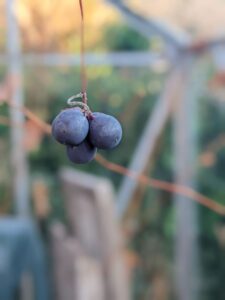
Raisins are dried Moscatel grapes. Thompson seedless is the variety generally used, particularly in the USA. If you have a greenhouse, then growing a grape vine is easy in most parts of Britain. There are also outdoor dessert grape cultivars but they will need a sheltered sunny spot to ripen.
Garden Teacher Tip
You need a dessert grape not a wine grape for the best result domestically. Although the main issue with growing grapes to turn into tasty raisins is going to be the sun-drying part of the process!
Spices – allspice, cinnamon, cloves, nutmeg
These would all require heat and protection over winter. As some of them are tall trees, it probably isn’t practical to grow your own unless you have a large greenhouse with a high roof.
Allspice, Pimenta dioica, is a dried berry. Cloves, Eugenia caryophyllus, are dried flower buds. Both are from the West Indies.
Cinnamon is the bark of trees from the Cinnamomum genus, which are native to the Indian sub-continent
Nutmeg, Myristica fragrans, is a nut from Indonesia.

Walnuts
Juglans regia, the common walnut has probably been around since Roman times. Nearly all Walnut trees grow very large, reaching 75 – 150 foot when mature, depending on variety. However, ‘Europa’ is a small cultivar growing to just 3.5m.
If you have the space, it’s worthwhile growing walnuts as they grow into lovely trees and provide fruit (nuts). Although be aware most need another tree for pollination.
Garden Teacher Tip
There may also be an issue growing certain other plants nearby as the Walnut gives out juglone, which suppresses their growth.

Grow Your Own Christmas Pudding – and then there are the other Ingredients
Beer
You’ll need to grow your own hops and barley and brew the beer. If you are growing wheat, then you could substitute that for the barley. Although it requires effort, it can be fun to at least have a go at growing hops and barley and brewing your own beer.
Hops are climbers and the system of poles and supports can be made over the winter months. They could be grown as a tunnel to provide shade so could be integrated into a larger kitchen garden this way. Remember, they need room to dry out once harvested.
Like hops, barley is ornamental to look at when growing. It likes plenty of sun, and a neutral soil. You could get plenty from a 10-foot square bed to make some homebrew. Malting small amounts is achievable at home.

Breadcrumbs
By which I’m referring to a stale loaf crumbled up, not a packet of breadcrumb to coat rissoles. Your bread is most likely made from wheat flour. Wheat, rice and maize are the most important cereal grain crops worldwide. You’ll need a reasonable amount of space to make it worthwhile growing, so unless you do have a couple of acres for wheat, you’re not going to be self-sufficient in flour. But you could grow enough for special occasion baking. Wheat grows best in a free draining, fertile soil; rainfall is more critical in the early growth stages. Then there’s all the fun of harvest time, threshing and more. On a practical note, you’ve got the stalks to make use of elsewhere, for example, animal bedding.

Photo by Guillaume Flandre
Eggs
Of course, you don’t grow the eggs, but your chickens – ducks – can produce them for you!

Sugar
There is a choice here between cane sugar and sugar beet. Sugar beet grows in the UK so is the obvious choice. A rough guide to processing it (which I haven’t tried myself) involves the beets being peeled, washed and boiled; then squeezed through a press like a cider press. Dried out in a flat dish. If, like with the wheat you only wanted to grow enough for special occasions, sugar beet doesn’t take up too much land. For example, a ¼ acre would feed a family for a year. Warning – this does not taste like bought sugar which goes through more processing!
Salt
You don’t exactly grow your own salt. It’s either taken from the sea or quarried (as in rock salt).
Suet
The word ‘suet’ comes from an old French word “su” which meant hard animal fat or tallow. This is the traditional suet. Animal fat suet has to be rendered, ie prepared. Vegetable suet is made from vegetable or palm oil and wheat or rice flour.

And finally
As for exploring whether you could grow your own Christmas pudding, why not get in touch? Designing edible gardens large and small is one of my favourite things!
Or if you’re looking for a Christmas gift with a difference, why not ask about our bespoke Gardening Lessons, where your classroom is actually your own garden? We can help with both gardening basics and more ‘expert tasks’, carry out worm and other experiments and for example, also show you how to plan a vegetable plot or kitchen garden. Have a read through this pdf download for info
For further gardening advice and inspiration, check out Plews Potting Shed blogs, including the selection below Plus we have a monthly Tipsheet You could come and find us on Instagram Pinterest and Facebook too.
And there are Gardening Gift Vouchers you can use for all our services – now there’s something to add to your Christmas list!
Feeling nosey? You can have a peek at the progress of my garden renovation, Spitfires and Slow Worms, on Instagram and Facebook
You’ll get to see it in person if you come to the Plews Gardening Workshops Although some dates still need to be finalised, there are a few up on Eventbrite for you to book into. Follow for updates on topics and dates on Instagram, Eventbrite, Facebook
Related Gardening articles you may enjoy from our Award Winning Blog
Growing Fruit
How to have a Mini Orchard in Your Garden
How to Grow Oranges and Lemons
Kitchen Gardens and more
29 Kitchen Garden Ideas for Leap Year
9 Winter Vegetable Garden Tasks to be Doing Now
What is an Ornamental Edible Garden?
Themed Edible Gardens
Growing New Potatoes for Christmas Dinner
Grow Your Own Thanksgiving Feast
Grow Your Own Pizza Garden complete with planting plans (and free printables)


