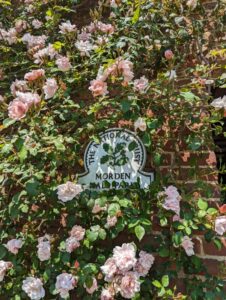
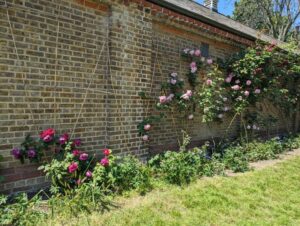
Morden Hall Park Rose Garden visit is about an early summer trip to a south London gem. It’s a personal medley of photos from an enjoyable garden visit, where I find a stream where one doesn’t normally find a stream – twice over. And a couple of other delights too.
Morden Hall Park – a brief history
To give you the setting for this rose garden within the larger estate. Morden Hall Park was originally owned by the Abbey of Westminster until the Dissolution of the Monasteries in 1553, when it was bought and brought into secular ownership. The Grade II listed hall was most likely built between 1759 and 1765, by Richard Garth. It was often tenanted rather than lived in. The most important change of tenure in Morden’s history began in 1867 when Gilliat Hatfeild bought part of the estate. He was a partner in the firm that ran the Morden snuff mill, which now forms part of the National Trust run property.
It was Gilliat Hatfeild who created a park we might recognise today, with planting of trees such as chestnuts and willows. However, we might not be so keen on the then common practice of demolishing cottages that was required to create the parkland.
In 1906 his son Gilliat Edward Hatfeild inherited the estate. During the First World War he loaned the Hall to the London Hospital as auxiliary military hospital and a soldiers’ convalescent home. Not such an imposition as you may think, as he actually lived in Morden Cottage rather than the Hall itself.
The snuff mill and tobacco company were closed down in 1922. A strike probably helping the decision of closing a no longer profitable business. However, the snuff mill workers hadn’t gone on strike and their loyalty was rewarded by being given jobs on the estate instead.

Morden Hall Park Rose Garden – from its beginning
In 1922 Gilliat Edward Hatfeild (G. E. Hatfeild) was quite a wealthy man and had only the previous year set out on creating the rose garden. This seems to be the only alteration he made to his father’s park but is an important one historically: the rose garden forms part of the Grade II listed area.
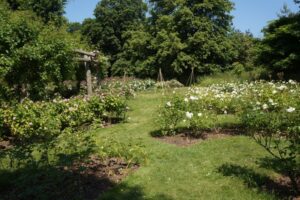
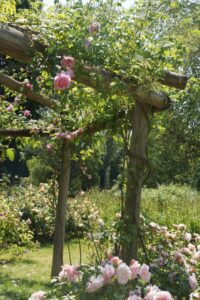
The layout is unusual for an inter-war rose garden and the design is considered to have been ahead of its time. Laid out in a combination of 48 rectangular and circular beds the Morden Hall Park rose garden cover approximately 2 ½ acres. A pergola covered with climbing roses was situated on the far side of the stream. The current rustic pergola is a new one, and added in 2017. In the beds were both standard roses and climbing roses on poles.
It is split into two part by a tributary of the River Wandle, which flows through the park. It’s possible that the stream has been here since Saxon times, and it defines the parish boundary of Mitcham and Morden (or used to). The original rose-covered rustic bridges are no longer there. There are plans to build replica bridges once funding is available, but for now a detour has to be made to cross over the stream.
E. Hatfeild loved his rose garden and kept his basket, secateurs and gloves conveniently to hand, secreted in a hollow tree. I love the tale told by those locals who remember, as children, seeing him meandering around, secateurs in hand, deadheading his precious roses. Gilliat Hatfeild died in 1941 and left Morden Hall and its estate to the National Trust.
Rose Garden Design in the 1920s and my thoughts
In its heyday, the rose garden must have been a spectacular summer sight and scent. But, not having yet discovered this through my, albeit brief, research, part of me wonders to what extent G. E. Hatfeild designed the beds and chose the rose varieties himself. The layout reminds me of some of Edward Kemp’s designs. Although fewer shapes are used, to my eye it has a feel of the “Unnatural Style”, which was a mix of the Geometric and Picturesque.
Kemp was a famous landscape designer and gardening writer in the 19th century and designed both private gardens and public parks, particularly but not solely in the northwest of England, including Birkenhead, Liverpool and Chester. A pupil of Joseph Paxton of Crystal Palace fame, Kemp himself was a great influence on other garden designers such as Thomas Hayton Mawson.
But I digress, my point was, that Hatfeild’s rose garden was of an unusual design for its era, when most were formal. For example, one might expect four quadrants of flower borders surrounding a central sundial or a pool. And with flanking borders planted with more roses, or a mix of roses, other shrubs and herbaceous plants.
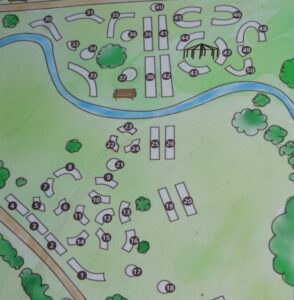
The design of the rose garden at Morden entices you into wandering around, there is no obvious route. Or perhaps it is an unmade jigsaw or a piece of machinery. Seen from above, or from the plan, there is almost a suggestion that if you were to join the shapes together you might make the cogs and wheel o the snuff mill. Or is that just my fancy?

Rose Varieties in Morden Hall Park Rose Garden
The layout of the rose beds and the varieties in each are in the photos above. If (when!) you visit, you may find that they are not entirely accurate and there is a very good reason for this, as we’ll see.
Unfortunately, there are no historical records of the original rose varieties. However, National trust gardeners have found two old labels identifying the varieties ‘Mrs AR Waddell’ and ‘Caroline Testout’.
The National Trust didn’t ‘take on’ the rose garden straight away in 1941 /2 as most of the estate was leased out to tenants. It was another 40 years before they took over the direct management of the estate, including the rose garden.
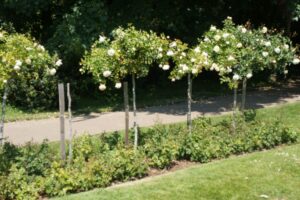
Between 1997 and 1999 roses were replaced with old varieties chosen for their colour and hardiness. These restoration plans were reviewed in 2013 as it was felt that the colours were too brash if the purpose was to reflect the 1920s. Rose varieties have since been chosen to reflect the period of the original Morden Hall Park rose garden but also for reliability and disease resistance. There are heritage varieties included in the planting and many standards have been planted. Currently there are around 1,600 individual roses and about 40 varieties.
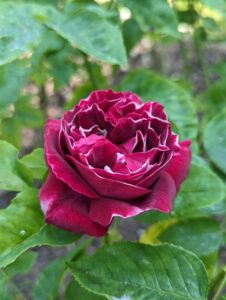
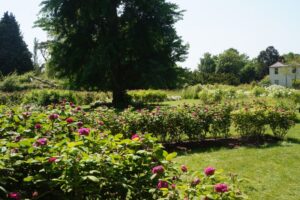
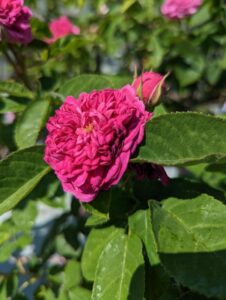
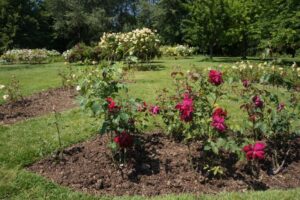
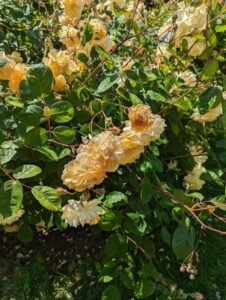
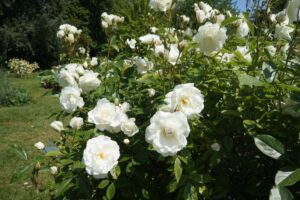
But for now, enjoy some a visual meander through the rose beds, on both the cottage side of the garden and across the stream where the new pergola now stands. The statuesque tree you see in a few of the photos is a Ginkgo biloba, a deciduouos conifer.









Still More Delights
And there is of course a second-hand bookshop. And yes of course I bought some books*, that’s why I had to go back to the truck and then back to the garden centre… you know me!
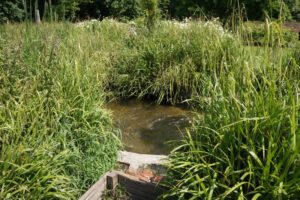
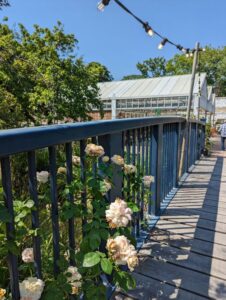
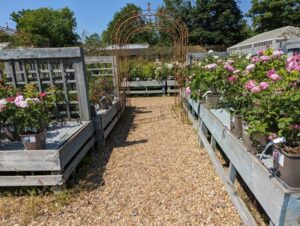
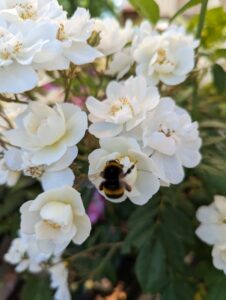
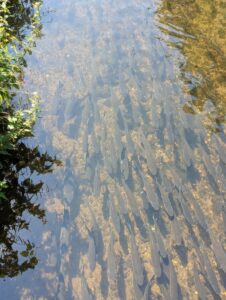
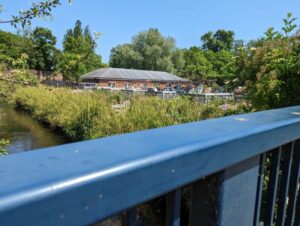
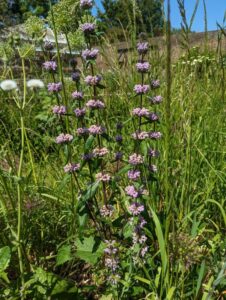
I do feel that the garden centre is also worth visiting because it has a stream running through the middle of it. And when I say through the middle, I mean you have to cross over one of the two bridges to get to the other half! The banks next to the stream were planted with a mix of predominantly native species and were attracting plenty of pollinating insects.
The plant centre and café were developed within the original walled kitchen garden in the early 1990s. But in 2015 the Nation Trust gained a double first at Morden Hall Park. Firstly they opened the trust’s first ‘proper’ garden centre. And secondly they were the first peat-free garden centre. In fact, the plants they sell are sourced from UK nurseries that grow seasonal, hardy plants in peat-free media and without artificially heated greenhouses.
*two carrier bags worth of heavy books actually, some of which were on my ‘ongoing list’. And with that, some essential purchases from the garden centre and an ice cream (it was a hot day), my visit to Morden Hall Park rose garden was done.
and finally, for more to look at and enjoy …
For more garden visits, gardening advice and inspiration, check out Plews Potting Shed blogs, including the selection below. The blog has been going for over 10 years, so there are plenty of gardening topics to ‘scratch your gardening itch’
More ideas and gardening advice can be found in other Plews Potting Shed blogs and our monthly Tipsheet . You could come and find us on Instagram – @plewsgd Pinterest and Facebook too.
And on that note, you can have a peek at my (new) garden at Spitfires and Slow Worms Instagram & Facebook
If you’d like some personal help, we offer a mix of practical sessions and theory in our bespoke Gardening Lessons and Courses. There’s a blog link below plus a pdf download with more info
Related Gardening articles you may enjoy from our Award Winning Blog
Rose Garden Visits
Roseto Comunale, Rose Garden, Rome
A Medley of Rose Garden Visits
Other Garden Visits
Stumpery Garden, Sizergh Castle
Garden History – Rievaulx Terrace
Rose Gardening Tips
Rose Garden Design Inspiration
Scented Roses, rose bushes, climbers, fragrant flowers
Romantic Roses for Valentine’s Day and Beyond