

If you were asked which English county grows the most lavender which one would you say? Norfolk? Would you be surprised if I told you it was Kent?
As I write this I have a small sachet of dried Lavender flowers within reach on my desk: a home-grown and harvested present from a planting design client in Bromley, which is in both Kent and Greater London.
But the lavender could just as easily have come from Downderry Nursery in Kent, where I recently paid a return visit.
Garden Visits Downderry Nursery
In a walled garden in Kent you’ll find one of the three National Plant Collections of Lavender. This one has been earmarked by Plant Heritage as a reference collection and as having scientific status. With some 250 species growing in less than 4 acres overall you could be forgiven for thinking a visit would feel like a trip to a research station not a walled herb garden. But it doesn’t. Getting out of your car just off a quiet country lane there is already a soft scent that is different to the surrounding wild honeysuckle and hedgerow greenery.
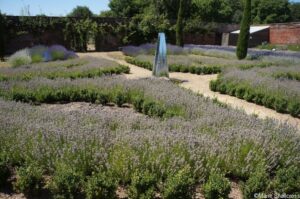
I admit I do aim to visit on a warm day so I can immerse myself in the pervading aroma of different lavender species mingling in the sun. Surrounded by high brick walls the perfume envelopes you as you walk through the gate and into the lavender nursery. Stand still and close your eyes for a minute. Then open them and enjoy the overview of all those different lavender bushes laid out in rows, in a parterre, in an oversized willow basket.
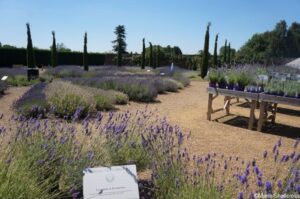
Ignore for now the temptation of the lavenders in their pots waiting for you to purchase and take home to plant in your own garden. You may indulge in a lavender ice cream though. It’s a good reason to sit on a seat and take in the garden before exploring in detail.
Garden Visits Downderry Nursery – the Lavenders
Although you can view the walled garden purely as an ornamental space filled predominantly with Lavenders it is more than that. As you would expect from a scientific resource, the plants are laid out in beds according to their species as well as in decorative format.
The genus Lavandula has recently been reclassified, so that the species are grouped into one of eight sections according to their botanical characteristics. This may be a shade too taxonomically taxing for this blog, so I’ll just give you a brief roundup of the main species that you’re likely to come across both here and at other lavender nurseries and garden centres. These are from the first 4 sections of the genus only.
Section 1 Lavandula
3 species
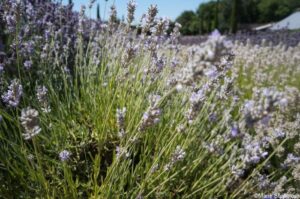
L. Angustifolia. Also known as True lavender and English Lavender, although it isn’t a native. Perhaps that’s because it’s the species that can reliably cope with the British climate and still give us scented flowers and evergreen foliage. Probably the best for flower fragrance and culinary uses due to a high concentration of oil.
L. latifolia, also known as spike lavender
L. lanata, also known as woolly lavender
2 hybrids
x intermedia, or Lavandin; crossed from angustifolia and latifolia. Widely used for the production of oil.
x chaytorae, crossed from lanata and angustifolia
Section 2 Dentatae
1 species
L. dentata
Section 3 Stoechas
3 species
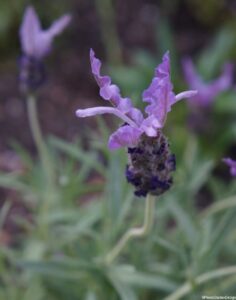
stoechas, also known as French Lavender, this is recognisable for its flowers with ‘ears’. These are actually modified leaves – bracts – but do give a decorative, butterfly effect to the flower. The foliage has a camphor aroma which some people find distracts from the flower’s perfume.
pendunculata
viridis
plus hybrids and sub species
Section 4 Pterostoechas
16 species, including
canariensis
pinnata
rotundifolia
1 hybrid

Garden Visits Downderry Nursery – the Walled Garden
Many gardeners love the thought of owning and gardening within the productive confines of a walled garden with its special microclimate. And I’m one of them, so I do love visiting walled gardens whether they’re kitchen gardens, rose gardens or lavender nurseries!
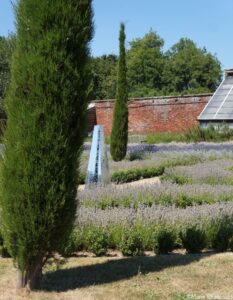
We may not all have the acreage of this plot, but some of the planting ideas would certainly transpose to smaller gardens. In a previous house, we had a lavender hedge surrounding the front garden: Lavandula angustifolia, as this is an excellent plant for this use. Although were I to plant another tall lavender hedge I would be tempted by L. x intermedia ‘Hidcote giant’. Such a gorgeous colour and scent, and good bushy growth. Although equally I might succumb to x intermedia ‘Provence’, especially if my soil was on the acid side of pH.

The parterre has a surround of box hedging with infills of two lavenders named after local areas. L angustifolia ‘Ashdown forest’ and x intermedia ‘Sussex’.
Garden Visits Downderry Nursery – Wildlife Garden
Despite the occasional plane flying overhead, it is the drone of bees not aircraft that epitomises this garden. The long hedges of lavender provide a veritable feast of pollen for bees, butterflies and pollinating wasps.
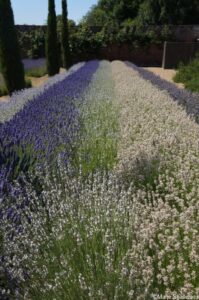
Pollinating insects are an obvious beneficiary of the lavender flowers. But other wildlife profit from the cover provided by dense planting and the dipping pond. If you want to encourage beneficial insects into a formal planting design, lavender is a good plant to choose.

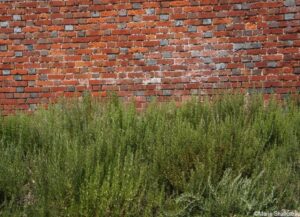
Downderry Nursery also holds a National Plant Collection of Rosmarinus, the herb Rosemary. As these herbs generally flower earlier than the lavenders, it increases the food source season for a range of pollinating insects.
Garden Visit Downderry Nursery and other Lavender Nurseries and Lavender Farms
Lavender is up there with Roses as one of Britain’s favourite flowers. This is about a garden visit to Downderry, which has the world’s largest collection of lavenders. However, it should be remembered that there are other Lavender Nurseries and Lavender Farms – in Kent, Surrey, Isle of Wight and of course in Norfolk, where they hold another National Collection.
The flowering period of the different lavender species varies slightly, so visiting between May and early September should provide at least some plants in bloom. Do allow for the vagaries of the season, as although Dr Simon Charlesworth, owner of Downderry Nursery rightly said:
“Lavender is a plant perfectly adapted to take advantage of global warming”
It is a plant which doesn’t like to have its roots in cold wet British soil! Which leads me onto a final point. If you’re planting lavender in your own garden, make sure that you get the soil right; it needs to be free draining and near to neutral, pH 7, for most varieties.
And if that sounds too complicated, you can always ask us to create a lavender planting design for you, or provide a garden consultancy visit.
Gardening articles you may enjoy from our Award Winning Blog
Garden Visits – Iden Croft Herbs, Mint, National Plant Collection
Inspiration for a Courtyard Herb Garden
Garden Visits – Brockwell Park Walled Garden
5 Scented Flowering Shrubs for a Midsummer Garden
Thyme for a Herb Garden
Garden Visits – Roseto Comunale, Rose Garden, Rome


