

Kenilworth Castle was given by Queen Elizabeth Tudor to her favourite, Robert Dudley Earl of Leicester. He built her new apartments to stay in and a garden to woo her into accepting his marriage proposal. Which makes the Elizabethan Kenilworth Castle garden the perfect garden visit to write about for Valentine’s Day.
Historic Garden Re-creation
Kenilworth Castle garden is very important historically. It is both a snapshot of the effort Elizabethan courtiers made when their queen visited and the high point of a style of English gardening. The mix of ornamental and edible planting in raised beds is arranged in geometric patterns. With paths between and surrounded by a trellis fence the garden is both historic and contemporary. It is a style that can translate well to a twenty-first century garden. One that provides easy maintenance gardening with fruit to pick and flowers to scent the evening air.
Using strawberries to edge raised beds enables the ripe fruit to be easily harvested. Growing strawberries like this in your own garden makes them easier to look after. They will need less watering than if they were in strawberry pots and are easier to weed if your raised bed is high enough – no kneeling down on the earth!

Whilst thrift (Armeria maritima) is not particularly scented, clove pinks (Dianthus caryophyllus) are very much so. Pinks, or carnations, were a great favourite of the Elizabethans who prized ‘gillyflower gardens’ for their redolent scent. These proved to be difficult to find, as many of the more modern varieties of carnations have had the scent virtually bred out of them. Dianthus – gillyflowers – were introduced into England in the 1540s from the Mediterranean. Some of those now growing at Kenilworth Castle garden were provided as seed by the Royal Botanic Garden Edinburgh. Some of the Dianthus are growing in special carnation pots displayed on pillars at the end of the terrace and steps, just as they would have been displayed for Elizabeth Tudor to have easily enjoyed their scent at nose level.

Personally, I have always loved the rich spicy scent of pinks. I remember them growing in my grandfather’s garden when I was a child, and have always grown them in my own gardens.
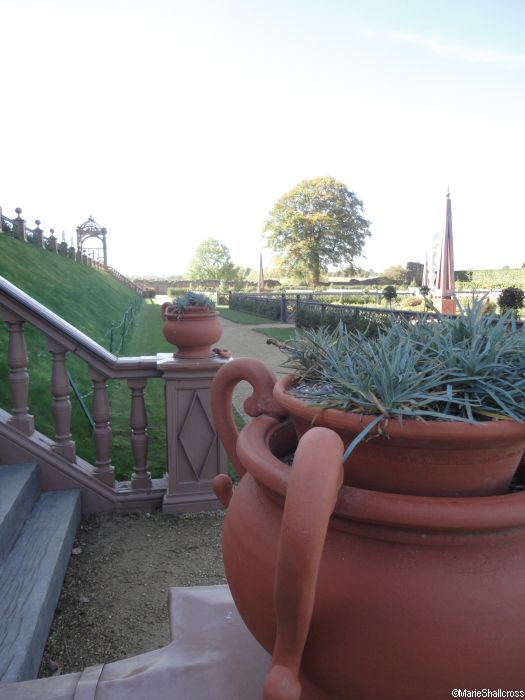
If sweet violets are the flower of love for Valentine’s Day with their delicate fragrance matching the soft light of February, then Dianthus’ heady perfume is evocative of long hot July days spent by a Queen and her favourite courtier in dalliance.
The Garden Design
The Elizabethan garden has a fountain in its centre, with the four quarters surrounding this each enclosed by split chestnut trellis fencing. Each of these quarters has a wooden obelisk structure, painted to look like porphyry. Building in wood and then painting it to look like a more expensive material such as marble was quite commonly done, even by the nobility. It is trick that can still be used to good effect in modern gardens
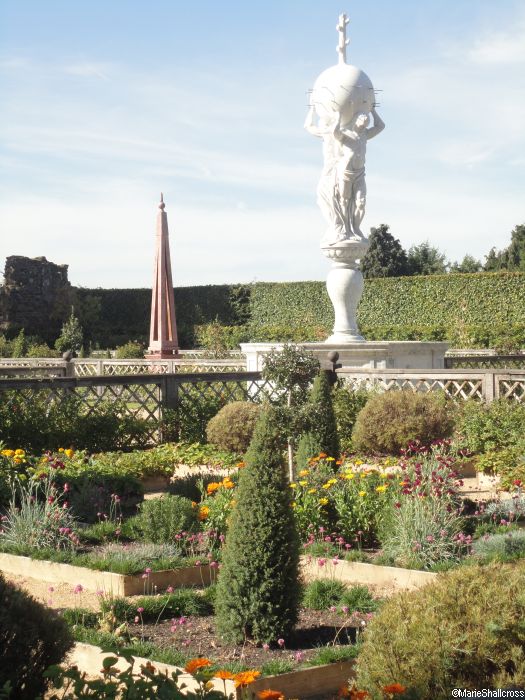
However, the central fountain is the real thing. The beautiful white Carrera marble fountain in the centre of the reproduction garden is placed exactly where the original stood in Leicester’s garden. Laser technology and archaeological finds of marble chips confirmed the placement of the fountain, whilst the size and design is taken from the detailed description by Langham, who was part of the entourage at Kenilworth Castle garden during Elizabeth’s stay in July 1575.

The diamond trellis fences surrounding the gardens within the garden are planted with eglantine (Rosa rubiginosa) also known as sweet briar rose. This romantic rose has flowers with a delicate apple scent and edible hips. Hawthorn and wild privet are planted with the eglantine to provide a mixed hedge that offers spring flowers and edible fruit.

Musk roses (Rosa damascena and others) climbing through a wooden arbour which is best placed to view the surrounding estate may suggest a larger garden than most of us own, but the privacy offered by such a seat is an element in some of our garden designs. Add a scented climber, roses or jasmine perhaps and it would make a perfect Valentine’s trysting spot.

An Elizabethan Planting List
Music may be the food of love, and there would have been minstrels serenading Elizabeth and Leicester as they strolled along the terrace overlooking the garden, but fruits and herbs were an intrinsic element of Elizabethan garden design. Situated around the garden, outside the fenced areas, a small orchard of fruit trees has been planted, with cherries, apples, pear and medlar.
English Heritage who manage Kenilworth Castle, have endeavoured to find varieties of plants that would have been available to English gardeners in 1575. This attention to detail includes the fruit trees. So you’ll find Pyrus ‘black worcester’, a pear of the period, and one that you can still buy today. Malus ‘pendu plat’ is an old French variety of apple, possibly dating back to Roman times. Some of these fruit trees would be a lovely addition to your own orchard, adding a depth of history as well as flavour to your garden.

The Elizabethan Gariden at Kenilworth Castle led to much research on what these late Tudor gardens looked like. Archaeology was useful, but in this case, so too was a letter written by someone who had physically walked through the garden. Who had enjoyed its pleasures of aviary, fountain, scent and colour for a few hours.
Langham’s letter to his friend, describing “The Magnificent Pageants presented before Queen Elizabeth” contains much information. He writes more on Kenilworth Castle garden structures than the plants, but I love this description:
“the sweetness of savour on all sides, made so respirant from the redolent plants and fragrant herbs and flowers…fruit-trees bedecked with apples, pears, and ripe cherries…all in such delectable variety, order, and dignity”
Sounds like a perfect venue for lovers to me, on Valentine’s Day, or in high summer.
and finally
The love affair between Elizabeth and Leicester was doomed (she said no) but they remained firm friends for all of his life. For inspiration from Shakespeare and links to find out more about Kenilworth look below
If you’d like a romantic garden design or an ornamental edible garden created, do please get in touch with us at Plews, we’d love to bedeck your garden with fruit and scented flowers.
And for further gardening advice and inspiration, check out Plews Potting Shed blogs, including the selection below and our monthly Tipsheet – You could come and find us on Instagram Pinterest and Facebook too.
Related Gardening articles you may enjoy from our Award Winning Blog
Romantic Gardens and Valentine’s Day Themed
Elements of a Romantic Garden for Valentine’s Day
Rose Gardens – the scent of Paradise
Red roses and sweet violets for Valentine’s Day
Violet flowers – Valentine’s Day in Your Garden
Shakespeare – Midsummer Nights Dream – Garden Design Inspiration
External Links
English Heritage – Kenilworth Castle


