Growing new potatoes during the autumn – a novel idea to you?
How do you fancy eating new potatoes for Christmas dinner along with your turkey? Its got a certain satisfying ring, hasn’t it? Growing new potatoes now will mean you can indeed eat new potatoes dressed with freshly picked Thyme alongside your turkey on Christmas Day.
Can I use any Seed Potatoes?
The tubers that are most reliable are those which have been cold stored by seed merchants. They are the same tubers that you would have bought in the spring to chit and plant out for your first early crop of potatoes, but their growth has been halted. This is because they’ve been kept in cold storage, at just the right temperature to keep them dormant.
You could try this yourself by keeping back some of the tubers you bought in late winter /early spring and storing them in the fridge. They will need regularly checking for aphids and may grow fragile sprouts; which is fine.
I’ve suggested a list of varieties you’re most likely to find in garden centres and on-line. They are usually sold as “Late cropping seed potatoes”. There are fewer certified organic seed potatoes available for summer planting, but you can still grow them organically.
Duke of York – heritage variety; good all-rounder Maris Peer – can be used for roasting as well as boiling / salads Gemson – bred from Maris Peer but not so good for roasting Nicola – longer than some other types; good resistance to slugs and eel worm Carlingford – high yielding variety; useful if you’re feeding the five thousand on Christmas Day! Charlotte – a popular variety for salads; good yields
Growing New Potatoes in the Autumn – getting started
You do not need to chit your late potatoes before planting them. They will take about 12 weeks to mature ready for harvest. You’ll be fine starting off your seed potatoes during September, and they will keep for a while once mature. The more northerly or exposed your garden, the sooner you should start.
You can to grow your Christmas potatoes in a potato planter or in the ground. Or both, if you like to hedge your bets! For the beginner, growing your Christmas potatoes in containers and raised beds is often easier than growing in the ground: –
Easier to keep slugs at bay
The soil is likely to be better drained, so there will be far less chance of rotting, should we have a wet autumn. This is particularly useful for those who garden in heavy clay soil.
You can protect potatoes in containers if there’s a heavy frost by bringing them under cover into a greenhouse or frost-free porch.
In more exposed areas of the UK, you could grow the potatoes in your greenhouse
Whether you’re a beginner or a seasoned gardener, if you’re limited on space in your vegetable patch, then being able to grow potatoes on the patio also has advantages.
Growing New Potatoes in the Ground
Difficult to be definitive as soil and aspect will vary; as will your preferred growing methods. I’ve presumed that you’ll be growing the potatoes in rows and that you’re practising crop rotation or other method to reduce soil borne disease such as blight.
Dig a trench or drill about 6” deep. This allows you to cover the tuber with about 4” of soil.
The soil should ideally have a pH5-6, so slightly acidic and be rich in humus.
It should also be free draining, to reduce the likelihood of the potato tubers rotting in wet autumn soil
Plant the tubers in the base of the drill, about 12” apart for earlies, 12-16” for second earlies and 15-18” for main crop varieties.
Cover the seed potatoes by using a rake or hoe to draw the soil over them and form low ridges over the rows.
Provided soil is moist you shouldn’t need to water at this stage.
Now there is a choice of methods, you could either –
The first shoots should emerge from the ridges after 3–4 weeks, depending on which type of potato you’re growing. The rows should be ridged up again to cover the shoots
Earth up two to three times as the foliage reaches approximately 6-9 inches in height. This stops any potatoes that grow near to the surface from turning green and inedible.
Or a less labour-intensive method
Now cover the whole area where there are planted potatoes with black membrane. This is to prevent light getting to the tubers and acts in the same way as continually earthling up the ridges.
Using membrane across the whole area also reduces weeds – and therefore weeding. The membrane is permeable to water.
The first shoots should emerge after 2-3 weeks, depending on which type of potato you’re growing. You’ll need to watch out for these, as you’ll then have to cut holes for the top growth to come through the membrane or plastic.
A downside of this method can be that slugs decide to live under the membrane, so it may not be practicable for your situation.
Growing Potatoes in Containers
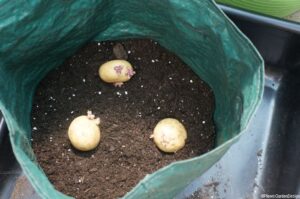
Whether you use specially bought potato sacks, a large pot or re-use a compost bag, the general technique is the same.
Use a container at least 12“/ 30 cm deep and about the same diameter.
Ensure there are drainage holes.
Put a 4”/ 10cm depth of potting compost or mixed garden soil and garden compost into the bottom. If the container is a lot deeper than 12” then make this a deeper layer.
Place 1-3 tubers into a 12” potato sack; ensuring the shoots, or ‘eyes’ are facing upwards.
Cover with 6” / 15cm of soil / compost and water well.
Put them in a warm position in your garden and keep them moist but not wet.
As the foliage develops, cover with more soil/ compost.
Leave a gap between soil and container top so you can water the growing potatoes.
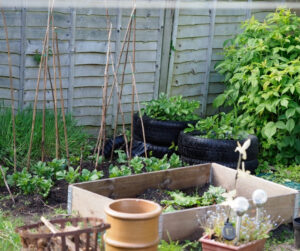
Growing New Potatoes in Raised Beds
This is almost a half-way house as the soil should be free draining, but you won’t have the option of bringing the potatoes under cover.
the membrane technique works well in a raised bed
it’s easier to protect from slug damage
when the weather turns colder protect the top growth from light frosts with fleece overnight
Problems
Slugs, eel worm, blight are your worst enemies. The above varieties have resistance to some or all of these. Blight is often less of a problem with late cropping potatoes as they develop foliage later. If your area is at risk of late blight, then grow the potatoes under cover to reduce the likelihood of infection.
A wet autumn is another problem, for which free draining soil and growing under cover are the best remedies.
Harvesting
New potatoes should flower about 12 weeks after planting. The foliage will turn yellow as it dies; frost damage will turn it brown. Cut off the foliage and compost it.
If they’re safe from slugs, then you can keep the potato tubers in the container or raised bed until you need them. I’d recommend digging them up if grown in the ground. Remember new potatoes do not store as well as maincrop, so keep them cool, dark and frost free.
On Christmas morning, harvest your new potatoes, scrub the dirt off the delicate skins. You may have been able to keep some mint growing to have with them; but thyme is a tasty alternative, and I think it complements the turkey better than mint.
There you are – growing new potatoes for Christmas needn’t be too arduous – and people will be so impressed that it ought to get you out of washing up all those dishes after the meal! And if you’re quick off the mark, you could have be growing and eating new potatoes at Thanksgiving! There are more ideas and growing tips in the blog links below.
If you would like help with learning more about your garden and gardening, why not ask about our bespoke Gardening Lessons, where your classroom is actually your own garden. We can help you learn gardening basics, carry out worm and other experiments and also show you how to plan an ornamental border or kitchen garden.
And for further gardening advice and inspiration, check out Plews Potting Shed blogs, including the selection below and our monthly Tipsheet – You could come and find us on InstagramPinterest and Facebook too.
Related Gardening Blogs from the award winning Plews Potting Shed