
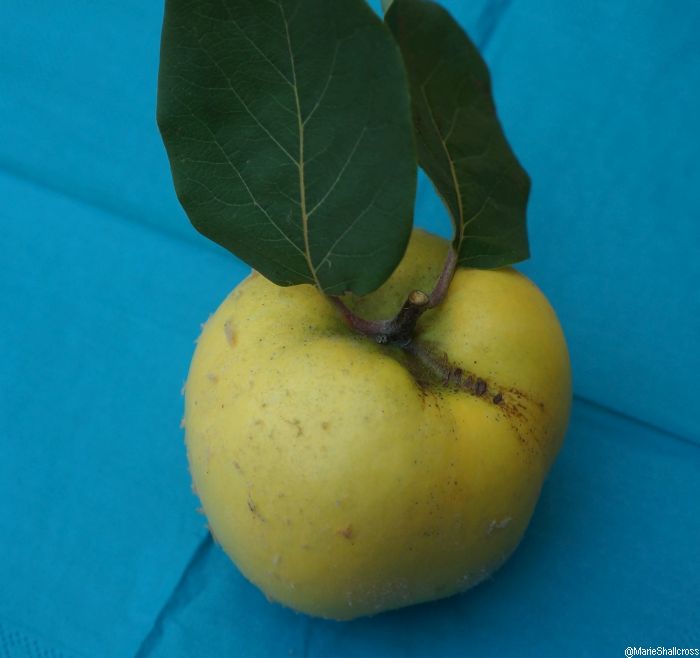
What is quince cheese?
It is a preserve made with the fruit of the quince tree.
Although it’s not the only way to eat quince. “The Owl and the Pussycat” the famous children’s poem by Edward Lear, includes the lines:
“They dined on mince and slices of quince
Which they ate with a runcible spoon”
But how many people these days eat slices of a quince that they’ve grown on a fruit tree in their garden? And actually, quince grown in Britain tends not to ripen quite enough to be eaten raw, unless we have a particularly hot summer. Quince jelly, quince jam are also delicious, but quince cheese is an especial favourite of my daughter’s, and quite rightly; it has such an exotic flavour!
Quince Cheese
Fruit cheeses are not actually cheeses; they’re more like a solid, sliceable jam. They have a long history as another method of preserving the harvest to feed the family and the household over the long winter months.
Quince cheese is the British version of the Spanish dulce de membrillo and is not difficult to make – assuming you can find some quinces that is. The fruit has a high pectin content, which means it sets easily when cooked and used as a preserve.
Fruit cheeses are generally made in conjunction with jellies. When the fruit is cooked and strained through a jelly bag, the juice is used for the fruit jelly and the pulp, once sieved, used for fruit cheeses. They can be stored in straight jars, turned out and sliced; scooped out of the jar and used as a thick conserve or jam.
However, my favourite use is when the quince is laid out to set in a shallow tray and then cut into slices and eaten alongside cooked meats and crusty bread for a tasty lunch or as a sweetmeat at teatime. This is the version that my daughter likes best, so I share it with you.
Quince Cheese – Recipe
- 2lb / 900g quinces
- Approximately ½ / 300ml pint water to cover the fruit
Method
- Thoroughly clean all pans, equipment and storage containers / jars before use, as you would do if making jam.
- Peel, core and chop the quinces. Place them in the water in the pan as you chop them to stop the flesh from browning. If necessary add a drop or two of lemon juice to the water.
- Bring to the boil; then simmer for about half an hour until the fruit has softened and cooked. The flesh will turn pink as it warms.
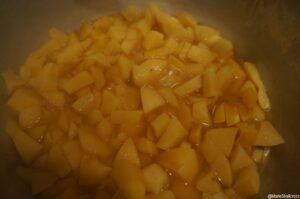
- Pass the fruit through a sieve to remove any stray seeds or skin.
- Weigh the resulting fruit puree and add 1lb / 454g of granulated sugar for every 1 pint / 300ml of quince puree.
- Taste, and, if you’re feeling decadent add a few drops of rosewater.
- Cook the fruit puree and sugar, allowing to simmer gently. Stir frequently until the mixture thickens to form a paste.
- Pour this paste into a greaseproof paper lined baking tray. The thickness of the poured paste isn’t critical as when you cut it later, you can adjust the size of the squares to suit the thickness of the quince paste.
- Leave it to cool and set overnight.
- Then cut the quince cheese into squares which are 2-4 bites’ size; ie similar to the amount of nibbling you would have with a piece of Turkish delight or Baklava but flatter.
Store in airtight containers and it should keep until Easter (although you will have eaten it all by then!)
Slices of Quince
As for Lear’s romantic owl and pussycat eating their slices of quince, the ‘runcible spoon’ was invented by Lear – or to be precise, the word ‘runcible’ was. Since the nineteenth century, definitions have abounded, one of the more common describes a ‘runcible spoon’ as a spoon with short prongs on the end, the easier to eat your fruit with, as you can spear it with the prongs but still use the bowl of the spoon to collect the juice. Sounds like a plan to me if you fancy some lightly poached, spicily floral slices of Cydonia oblongata for afternoon tea.
And it seems to me to be particularly apt to be romantic, as this blog is published at the same time as my darling daughter who loves quince cheese is getting married. Quince was considered sacred to Venus, the goddess of love in Roman mythology and as such was eaten at wedding feasts. And as for those of you who are wondering why I haven’t written a wedding flowers blog for her, that is still to come…
If you’d like an ornamental edible garden or mini orchard with quince trees so you can make your own quince cheese – get in touch we’d love to help create one for you!
Related Gardening Blogs from the award winning Plews Potting Shed
Strawberries and champagne – Grow your own Wimbledon Treat
Growing New Potatoes for Christmas Dinner
Edible flowers – Eating your Flower Garden
5 Grow Your Own Foods to eat with your Thanksgiving Turkey


