

Plants called Snake in celebration of Chinese New Year 2025, for your delectation – 15 in total. Houseplants and hardy perennials plus a few tender plants that can sit in your garden in the warmer months.
As an idea for 2025 – and beyond – these plants into a themed planting scheme for a border or indoor plant collection that would last throughout the Year of the Snake.
But first, the list of 15 plants. And yes, it is in botanical Latin for the very good reason, as you will see, which is that more than one of them share a common name! That would get very confusing. But I give the common names aswell when we look at the plants on more detail.
- Actaea racemosa
- Arisaema speciosum
- Calathea crotalifera
- Darlingtonia californica
- Dracaena trifasciata
- Eryngium yuccafolium
- Eupatorium rugosum
- Fritillaria meleagris
- Goeppertia insignis
- Hosta ‘Snake Eyes’
- Ophiopogon
- Rhinacanthus nasutus
- Scadoxus puniceus
- Tillandsia caput-medusae
Next we look at these plants under the headings of houseplants and hardy or outdoor plants. Easier for you to find what you want that way!
Hardy Perennial Plants called Snake
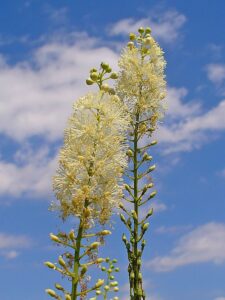
Actaea racemosa
With common names including black snakeroot, rattleroot, rattlesnake weed and Virginia snakeroot, this is a good one to start with! Also known as Cimicifuga racemosa, it carries white bottle brush flowers on stems to 5 foot over dissected foliage. Best grown in partial shade and any soil that isn’t too dry.
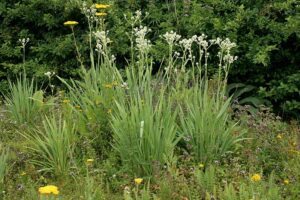
Eryngium yuccafolium
Synonym Eryngium agavifolium. A dramatic addition to a sunny border with spiny blue-green leaves forming a mounded rosette. Another perennial whose flower stems reach 5 foot, this Eryngium is hardy in the UK. It’s known as button snakeroot because the roots were thought to be an antidote to snake venom.
Eupatorium rugosum
Also known as Ageratina altissima, there are quite a few Latin synonyms for this plant. But we’re interested in its common name of white snakeroot. Small white flowers in summer and early autumn contrast with purple stained, dark green leaves. Happy in sun or light shade.

Fritillaria meleagris
Snakes head fritillary was mentioned by Shakespeare and at one time filled Covent Garden flower market in spring. Its nodding, pink-and-purple-chequered flowers of the snake’s-head fritillary are said to resemble a snake. Best grown in slightly damp soil, next to a garden pond perhaps.

Hosta ‘Snake Eyes’
This one is an obvious inclusion! The leaves have a pale green central streak, usually edged with white on a dark leaf and have a look of snake eyes about them. If slugs are a problem grow in a pot and take the ‘usual precautions’ such as a ring of copper tape.
Ophiopogon planiscapus
Did you know one of its common names is snake beard? Not because of being a venom cure but curiously because of its tufted growth. The name Ophiopogon is derived from the Greek ophis (snake) and pogon (beard), and probably refers to the leaves and tufted growth of this adaptable perennial.

Houseplants for the Garden
These plants called snake are happy in your garden during the warmer months but will need frost protection over winter. If you have a coastal or sheltered garden they may be okay outside, but if pot grown, be ready to take them in if frosts are due.
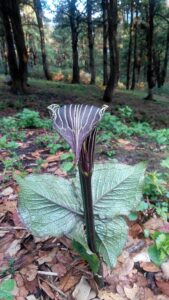
Arisaema speciosum
Japanese cobra lily is related to Calla lilies (neither are actual lilies!). It likes to grow in moist but well drained rich soil out of the hot sun. If you lift the tubers overwinter to store frost free be sure to keep them moist.
NB All parts of plant contain calcium oxalate crystals, an irritant to the mouth and throat
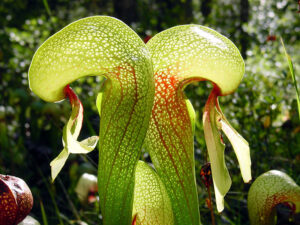
Darlingtonia californica
Another cobra lily, this one is carnivorous. I love its tubular leaves that look like a rearing cobra, complete with a forked tongue (ie leaf) poking out. Also known as Californian pitcher plant. It likes to grow in moist but sharply drained acid soil in full sun. Only use lime-free water.
If you feel it’s too cold in your garden overwinter, the above two plants would be fine in pots in an unheated greenhouse or porch.
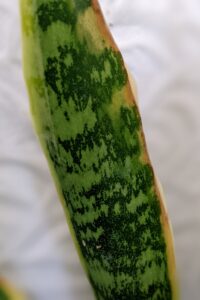
Dracaena trifasciata
Also known as Sansevieria trifasciata, this snake plant has many other common names including tiger plant and viper’s bowstring. The banded, sword-shaped leaves do look very snake like. Surprisingly hardy in many, more sheltered UK gardens, it’s also very tolerant of neglect as a houseplant (just saying!) It prefers a shady spot wherever you grow it.
Houseplants
These plants called snake are tender and tropical plants so definitely come under the houseplant category in the UK.
Calathea crotalifera
Although quite a few Calathea have the common name of rattlesnake plant, I feel that Calathea crotalifera is the most appositely named. Why? Because Crotalus is the generic name for rattlesnakes!
Goeppertia insignis
This rattlesnake plant is grown for its decorative foliage that has dark splodges on either side of the midrib. Very snake-like.The underside is purple. Synonymns include Calathea lancifolia

Rhinacanthus nasutus
Snake jasmine is a slender, somewhat hairy shrub growing to 1–2 m. A tropical plant used as a treatment for snake bites, you could grow it in a warm conservatory .

Scadoxus puniceus
Snake lily was a popular ornamental exotic plant in the 18th century Netherlands. Its showy red paintbrush flowers account for its other common name. An interesting houseplant to grow, keep it out of strong sunlight.

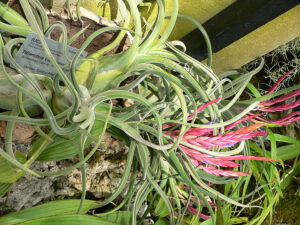
Tillandsia caput-medusae
This cobra lily is commonly known an air plant, an epiphyte, growing on trees for support but not feeding from them. Tillandsia caput-medusea has tentacle-like leaves, hence it was named for the Greek goddess Medusa who had snakes for hair.
And finally
There are blog links below on other themed planting ideas for you to peruse and be inspired. And if you’d like personal help with designing a border of plants called snake in your own garden, do get in touch.
Or why not ask about our bespoke Gardening Lessons, where your classroom is actually your own garden? We can help with both gardening basics and more ‘expert tasks’, carry out worm and other experiments and for example, also show you how to plan a vegetable plot. Have a read through this pdf download for info. And if you prefer company, there are small group Gardening Workshops to come to.
For further gardening advice and inspiration, check out Plews Potting Shed blogs, including the selection below Plus we have a monthly Tipsheet You could come and find us on Instagram Pinterest and Facebook too.
Feeling nosey? You can have a peek at the progress of my garden renovation, Spitfires and Slow Worms, on Instagram and Facebook
You’ll get to see it in person if you come to the Plews Gardening Workshops Although later dates and topics still need to be finalised, there are already a few up on Eventbrite for you to book into. Follow for updates on topics and dates on Instagram, Eventbrite, Facebook
Related Gardening articles you may enjoy from our Award Winning Blog
Many of these have planting lists for you to download too
Previous Chinese New Year
Chinese Flowers for Chinese New Year
Themed Planting Design Ideas
Wedding Anniversary Roses for Your Garden
Would You Like a White Garden or a White Flower Border?


