Mood boards for garden design planning is not a new idea. Garden designers and interior designers have been using them for years as part of their design process. They’re a useful tool to show clients particular samples, materials, colour schemes, options. Years ago they were literally boards; these days they may be actual physical boards or they may be an image, depending what needs to be shown.
If you’re a Pinterest user, you’ll probably have a garden design board with pictures of gardens you’ve seen on there. You may even have other boards for patios, kitchen gardens, seating. Or perhaps you like Unsplash or Pixabay and have collections (which are the same as boards) on those photo sharing sites. These aids can be really helpful in the ideas stage of wondering what you would like in your redesigned garden. And you may be creating your new garden yourself or using a garden designer and landscaper.
However, one of the downsides with using photo sharing sites is that you can spend hours on the internet without actually getting any planning done. Because yes, we do need to plan. You know the adage “fail to plan and you plan to fail”? But in order to plan well, most of us first need a vision to aim towards.
Garden Design Themes
All garden designs have a theme, an often a specific idea that sparks the concept and helps to pull together all the elements of the finished garden.
Sometimes the theme is fairly loose, perhaps based on a planting style such as a cottage garden. Or perhaps the theme is more apparent, for example, a UK hardy Mediterranean courtyard garden with perennial plants.
Let’s work on the basis that you have a plethora of images but don’t know how to decide between them to sort them out. A garden design tip is for you to write down three gardens that you’ve visited or seen that appealed to you. Consider them – are they similar? For example, are they kitchen gardens or Tudor knot gardens?
If they are similar, then pop them all into one folder. If they’re different, then make two or three folders, ie one for each. NB when I refer to folders these could be real or virtual.
Mood boards for Garden Design Planning
These mood boards can also be either or both virtual and real scrap book: it’s your choice. Oh and if you prefer the term ‘ideas board’ then use that instead.
Focus on one of your chosen themes at a time. Find pictures of gardens like your theme, as a whole, and of particular elements and plants, in magazines and on the internet. And of course from photos you may have taken yourself.
Then you create mood boards, which is niching down further into what it is that appeals to you about each theme and the elements within that theme.
You can make as many mood boards as you want. These are not necessarily your final choices, but they are leading you towards those decisions.
For example:
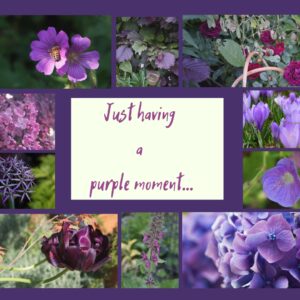
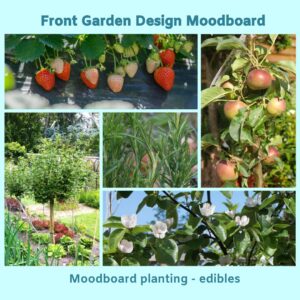
As it’s helpful for both designer and client to see pictures of the likely plants to be used in the garden design, for this cottage garden design for a front garden, I created a range of boards, of which these are just two. There is a summer floral snapshot, in the clients’ preferred purple, pale pink and white colours. And I also provided a winter, more foliage based, mood board. It’s important in a front garden to have something happening in all of the seasons. The other mood board is one edible plants, mainly perennial fruit.

Garden Paths
I do love a path that entices you into exploring a garden. Whilst straight paths are generally the best option for getting to a specific place, such as your potting shed, curving paths can lead you on a journey of discovery through the garden. These are examples I created as part of the presentations for various clients.


Patios and Decking
Who says patios always have to cut straight across the garden? Not me, for sure!
Whether it’s a patio, terrace, veranda or decking this area should be planned and designed as part of the whole garden. Building it so it cuts horizontally across your garden can make your garden feel smaller and may not be the best use of space.
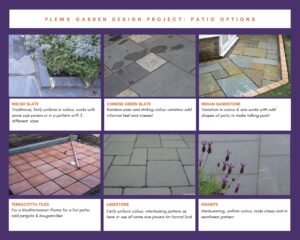
Consider when and how you want to use your patio, whether you prefer sun or shade before you even get onto which pavers or wood surface you’d like. Next to your house is not always the best place. Working out the pros and cons of different surfaces is crucial in deciding which will suit your lifestyle, look lovely and be within budget.
Mood boards for garden design planning can be useful for this stage of planning as the visuals and info sit next to each other and are easy to compare.
Garden Sundries
Sundries are items such as water butts, garden furniture and compost bins.
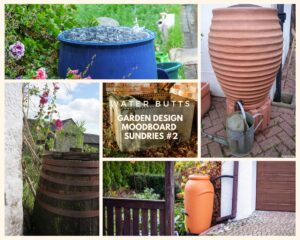
Mood boards for garden design planning are also useful when you just want to tweak what you already have. For example, perhaps you need to replace your garden furniture.
When planning the finished visual effects of the garden, a garden designer needs to consider not only the planting, the edges of the borders, how the brickwork is laid to create a pattern… but also the furniture colour and style, regardless of whether choosing new furniture was part of the brief. Keeping existing furniture and ensuring it works with the new garden is just as important!


And finally
If you’d like help with designing your garden, or have queries regarding your existing planting, do get in touch to ask about our design and consultancy services.
For further gardening advice and ideas, check out Plews Potting Shed blogs, including the selection below and our monthly Tipsheet You could come and find us on Instagram @plewsgd Pinterest and Facebook too.
You could have a peek and follow how I approach my own seriously overgrown new garden – Instagram @spitfiresandslowworms and Facebook – Spitfires and Slow Worms
And if you’d like some personal help, perhaps learning how to design your own garden, we offer a mix of practical sessions and theory in our bespoke Gardening Lessons and Courses. There’s a blog link below plus a pdf download with more info
Related Gardening articles you may enjoy from our Award Winning Blog
Gardening Courses and Lessons
What might a Plews Gardening Lesson be Like?
Plews Gardening Lessons Information
Garden Design and Planting Design
What is Garden Design? A Green Vision
Should You use a Garden Designer?
Types of Gardens
Creating a Mini Cutting Garden
5 Front Garden Ideas for a Practical Pretty Space
What are the Key Elements of a Formal Garden?
Wild about Gardens – Design Ideas for Humans and Wildlife
What is an Ornamental Edible Garden?
Tips for Planting a Coastal Garden
Garden Inspiration
Bark and Stems for Winter Gardens
9 Edible Annual Flowers to Grow in Your Garden
Would You Like a White Garden or a White Flower Border?
Rock Gardens – Plants and Ideas
Is that a Pergola or an Arbour?
Hard Landscaping and Sundries
What Type of Decking Material is Best for Your Garden?
Tips on Choosing Seating for Your Garden
Garden Sheds and Garden Design Tips