

Is a palm tree really a tree? You may wonder why I’m even putting the question: of course it’s a tree! Well, actually…
Palm Trees
Many palms are tall plants that are certainly tree like with their height and a trunk that can be climbed up to collect dates and coconuts. Or to stand proud in British coastal towns and seaside resorts. They’re also used in exotic gardens and Mediterranean planting schemes. In large urban conurbations palms may also be planted, as the warming effect of all those buildings often allows the more tender types to thrive.
However the description ‘palm’ or ‘palm tree’ is often used in a way that is more colloquial then factual. Of course, there’s nothing wrong with that easy way of speaking in general conversation. But there are times when we need to know more precisely what sort of plant we’re talking about, because otherwise we’re not going to know if we can successfully grow it in our gardens.

But is a Palm Tree Really a Tree?
Palms, true palms, are members of the Arecaceae family, sometimes also referred to as the Palmae family. There are some 188 genera (plural of genus) and 2,585 palm species. These are naturally found in tropical and subtropical habitats, but quite a few have become naturalised in warmer temperate areas, having originally been introduced as garden and park specimens.
Now perhaps another time I’ll go into the detail of plant classification and how you can use it to better your gardening and plant skills. (Or maybe not – would you like me to? Let me know) For now, just understand that ‘true’ trees are dicots, as they have two leaves, known as cotyledons, within their seeds. Palms, on the other hand are monocots, meaning they have only one embryonic seed leaf.
Another family of plants which are monocots are grasses, or Poaceae. This family includes bamboo and the cereal grasses such as rice and wheat. Both grasses and palms are grouped into commelinid monocots, as they have certain characteristics in common.
So far, palms would seem to be more grass like than tree like. But what about that thick trunk that supports the impressive leaves? Surely that makes a palm a tree? Well, no. Because it isn’t a trunk exactly.
The two components of tree trunks which are relevant for our comparison are cambium and bark. A tree has a cambium layer which is the part of the trunk and which grows and expands the size of the tree. It is the part of the tree which creates the rings that tell us how old the tree is. The bark is the outside edge of the tree trunk and its main function is to protect the living tissue, ie cambium, from damage. Palms do not have a cambium layer or bark.
Case studies: Is a Palm Tree Really a Tree?
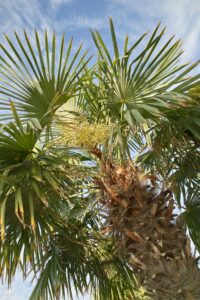
Trachycarpus Fortunei, the Chusan Palm or Windmill Palm, is a must-have addition to an exotic garden scheme. Not in a windy spot though as that will rip through those large fan shaped fronds. A hardy palm with a hairy trunk, once mature it will produce yellow flowers in spring. We know it’s hardy as one of the first specimens grown by Kew, c 1836, died because they grew it in the tropical house. The one they planted outdoors in 1849 thrived, even in the snow.
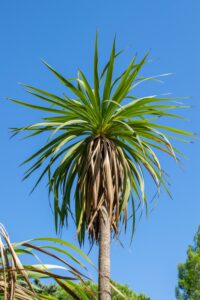
There is a popular palm found in British seaside resorts such as Torbay. You must have heard of the Torbay Palm as a common rather than Latin name for Cordyline Australis? It’s also known as the cabbage palm and Cornish cabbage palm. With tall trunks and spiky leaves this palm gives an exotic air to coastal gardens reminding us perhaps of holidays in the Mediterranean or Florida.
Only it isn’t a palm. For once this palm tree is actually a tree. It has grey corky bark and a cambium layer.
Tree Preservation Orders (TPO)
In conservation areas, trees that have a trunk diameter of more than 75mm when measured at 1.5m from the ground have an automatic TPO. Fruit trees are generally exempt from needing permission for pruning. However the question: “is a palm tree really a tree?” becomes important if, for example, an owner wishes to remove a palm tree that has outgrown its space.
It is simple enough to prove that Trachycarpus Fortunei, is really a palm and not a tree. If you’re having a dispute with a local planning officer who just hears the word ‘tree’ when faced with a large, single stemmed palm send them to look at palmweb.org
With a Cordyline Australis you have a harder task, as it is, as we’ve seen, a tree. And I have heard that some of those on the south west coast have had TPOs given to them. But part of the reason for having a TPO is that the tree provides an amenity. For example, passers-by enjoy looking at it. If your specimen is one of various shrubs trees and plants in your back garden and not really visible except to a few neighbours, you may find a sympathetic ear. Or perhaps it’s visible but has become a very scruffy specimen that is never going to look good again so there isn’t really any amenity value.
On the other hand you may have local officials who hear ‘palm’ not ‘tree’. Who knows. It is a bit of a grey area. I’ve had a few occasions over the years where a sympathetic officer has been happy for us to replace a tatty Cordyline with an impressive Olive, Quince or ornamental cherry tree.
And finally
If you need advice about the trees or palms in your garden, do get in touch to ask about our consultancy and design services.
For further gardening advice and inspiration, ideas for bee friendly gardens and more, check out Plews Potting Shed blogs, including the selection below and our monthly Tipsheet You could come and find us on Instagram – @plewsgd Pinterest and Facebook too.
And you can have a peek at my new garden too on – Instagram @spitfiresandslowworms and Facebook Spitfires and Slow Worms
If you’d like some personal help, we offer a mix of practical sessions and theory in our bespoke Gardening Lessons and Courses. And here’s a pdf download to answer some of your questions – Plews Gardening Lessons Information
Related Gardening articles you may enjoy from our Award Winning Blog
Trees in the Garden – Questions and Answers
What makes a Garden Consultant different to a Garden Designer?
Tips for Planting a Coastal Garden
How to Choose a Tree for Your Garden
Is Yours a Shady or a Sunny Garden?
What are the Key Elements of a Formal Garden?


