

Even small alterations in domestic gardens can make a big difference to the planet. This is one of an occasional series that will give you tips to make being a ‘green gardener’ a lot easier than achieving a gold medal.
I know we often have more rain than we could care for in Britain; especially if it’s a bank holiday, it seems! With the Easter weekend approaching, and the days becoming noticeably longer, a long weekend feels like the perfect excuse to get gardening. The sky is blue all week, and then it chucks it down as soon as most of us finish work for a four day holiday.
Irritating as it is to see the garden disappear under a sheet of rain or sleet, we should be grateful. All that wet stuff is filling up the reservoirs and underground aquifers that both we and the plants will need when we get to a long hot summer.
However much water falls from the sky; fresh water, as distinct from salted, is a finite resource. It is constantly recycled, not just by humans, but by raining on the ground, thence into streams, then taken back up into clouds to fall again as rain. You may vaguely remember learning about the hydrogen cycle when you were at school – that’s the bit about water going round and round from sky to stream and sea and back again.
Water, fresh water, is a valuable resource, even in soggy Britain. So I thought sharing some ideas for how we can easily adapt habits to reduce our use of water in the garden might be useful for you.
Green Living Water Conservation
If you have room for a water butt then you should have one – or two.
They come in various shapes and sizes from huge below ground tanks to slim wall hung versions so there should be one to fit your garden.
Collecting the water off greenhouses and garden sheds is a simple task and the resulting water is better for your plants than tap water. Many garden buildings are sold with built-in guttering; if not it can generally be added as an optional extra. It is a simple job to buy some guttering and attach it to your garden shed; then add a downpipe that feeds directly into your water butt.
Conservatories and kitchen extensions often have separate run of guttering from the main house roof, making them ideal to feed into a water butt or a pair of linked water butts.

If lugging a watering can from water butt to plants is a problem for you, there are systems which will link your water butt water to the plants in need of a drink. These can be useful if you’re regularly away but love having thirsty summer bedding plants in patio pots.
Green Living Water Recycling
You can also use ‘grey water’ for watering any thirsty non-edible plants, ie ornamental flowering plants and shrubs; thirsty, newly planted trees.
It may be too complicated for you to have a pipe system running from your bath or shower down to the garden. Some new build properties have a system so that use this water can be used for flushing the loo.
However, the easiest way to re-use grey water is probably the simplest. Have a bowl in the kitchen sink and use the water from washing your hands to water your patio pots which will, of course, be just outside the back door and only a step away from your sink.
If you wash your dishes by hand this water can also be used for watering flowering plants and newly planted shrubs as well as for annual bedding plants. It is better to filter out any residual food waste that may be in the bowl first. I find this is easy enough to do by keeping a bucket to hand, and pouring the dish water through a sieve from the bowl to the bucket. The bucket is a good trick as you can throw the water into it during the day and then only have one trip outside!
Grey water doesn’t store without treatment so use it within a day.
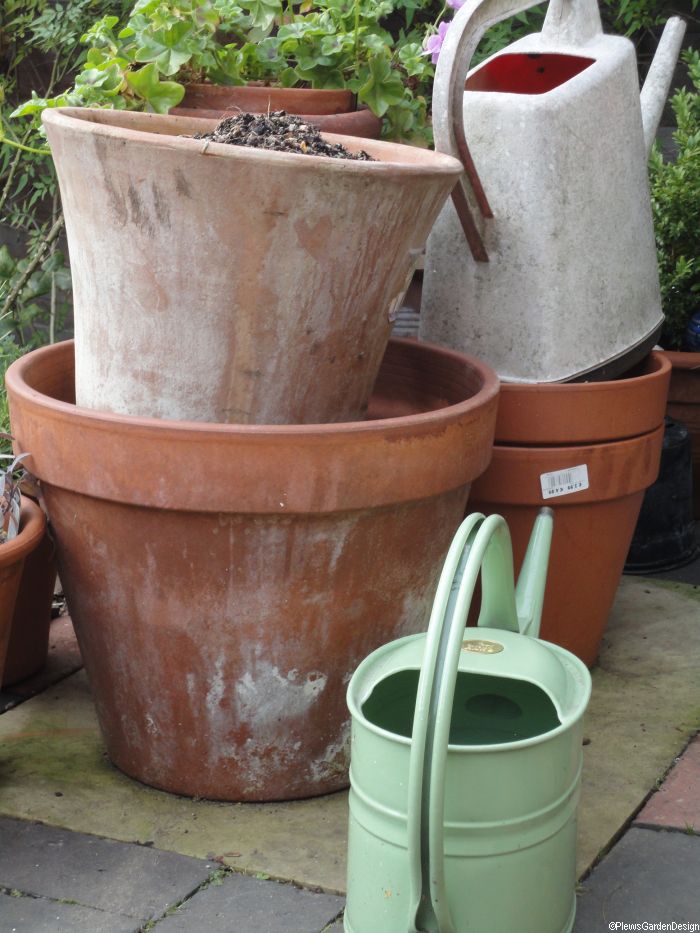
Green Living Water and Watering
Before you water your garden, ask yourself: is that plant really thirsty?
Established plants and lawns tend not to need extra watering by us humans. There will be some exceptions, flowering herbaceous perennials under the shade of a tree, for example, plus fruit bushes and trees at key times such as pollination & fruit setting.
Make sure the water gets down to the roots, which is where it’s needed. Check the soil at root level by gently digging down. If it’s damp then the plant doesn’t need watering.

Dry soil on the surface is fine, so long as it’s not crusting over. This would cause rain to bounce off the surface rather than be absorbed. Break it up with a hoe if necessary. Make a note to add more organic matter in the autumn, as this will reduce the crust effect.
Plants in a rain shadow – under trees, against fences, in a porch will possibly need watering even when it rains, so do check.
Water thoroughly but not often, to encourage the plants to send their roots deep into the soil where there’s more likely to be stored water. Exceptions would be annual vegetables and some annual bedding.
Watering in the evening or early morning reduces evaporation (water loss) so the plants get maximum benefit.
If slugs and snails are a problem, then you may find watering in the morning rather than the evening is better. This reduces the moistness around the plants overnight, when those gastropods are most active.
And on that note, I’m off to water my seedling sweet peas; if those blinking snails haven’t eaten them…
Related Gardening articles you may enjoy from our Award Winning Blog
Holiday Gardens – maintaining your garden when you’re away
Six New Year’s Resolutions for your Garden
 the watering pond in Scotney Castle walled vegetable garden


