

13 Black fruits to grow for Halloween – because it’s a fun, spooky idea but one which allows you to be sustainable and grow your own too. Because after decorating your Halloween feast and garden with the spooky fruits (and a few cobwebs) you can continue to eat and grow the fruit.
And if you’re not inclined to do the whole spooky thing, there are the health benefits: generally speaking, black fruit is high in antioxidants.
But firstly, let’s have our list of 13 – the number chosen for its superstitious qualities, of course!
- Black Raspberries
- Blackberries
- Blackcurrants
- Cherry
- Elderberry, Sambucus nigra
- Goji berries
- Gooseberries
- Grapes
- Hungarian Black Hawthorn
- Mulberry, Morus nigra
- Olives
- Pear Black Worcester
- Plum, Black
Why Grow and Eat Black Fruits?
The secret lies in the colour, or rather the pigment anthocyanin, which makes the fruit black or deep purple. Well, not just the fruit but the leaves, stems and flowers too.
These anthocyanin pigments are powerful antioxidants that may help boost the immune system. And a strong immune system helps to maintain our health and fight off infections. Anthocyanins may also offer anti-inflammatory, anti-viral, and anti-cancer benefits. They wont of course do this on their own, but as a part of our balanced diets, they are most definitely good for our overall health.
13 Black Fruits to Grow for Halloween
I’m hoping that quite a few of these edible plants will be new to you as it’s always fun to try something different. For some of them, the Walnut for example, you will need a large garden. But others such as the Gooseberries can be grown in a decent sized container.
And, as with any fruit or vegetable that’s new to you, I suggest you taste them before you start growing them. There’s no point spending al that time growing fruits that you don’t want to eat when you harvest them!
Black Raspberries
The first of our black fruits is different to the red and yellow raspberries we’re used to. It’s been described as tasting “as juicy as a blackberry, but with the texture and sweetness of a raspberry”.
The black raspberry originates from North America and has been grown as commercial crop in the UK for the last ten years or so. However, there are plants available for the amateur gardener to buy and grow; look for Rubus occidentalis and Rubus leucodermis. Both require similar growing conditions and care to the raspberry we usually grow. Harvesttime is in June and July.

Blackberries
Okay, so you won’t be surprised at my including blackberries in this list as they are amongst the most familiar and easily recognized of berries. If you have a small garden, it may be a better idea to limit yourself to blackberry picking when out for a walk in late summer.
But if you have a woodland edge or shady garden, you’ll be pleased to know that the blackberry, Rubus fruticosus, is one of the fruits that will crop well without full sunlight.
Blackcurrants
The Blackcurrant bush, Ribes nigrum, is fairly easy to grow and is happy in a container or in the ground. The compact variety ‘Ben Sarek’ is good for container growing.
Blackcurrants crop best on strong young growth made the previous year. Annual winter pruning ensures a supply of these stems and creates a multi-stemmed bush.
Cherry
The Black Cherry, Prunus serotina, also known as American Cherry is related to the bird cherry, Prunus padus, and chokeberry, Prunus virginiana, rather than the domesticated sweet cherry, Prunus avium.
A deciduous forest tree, potentially growing up to 70 foot, I’m including it here for interest as there are some concerns as to its propensity to take over an area and create problems for native plants and animals. Popular as an ornamental in the mid 20th century it can be found in many parks and gardens.
And anyway, a better edible almost black cherry to grow is Prunus avium ‘Lapins’ also known as ‘Cherokee’. A self-fertile sweet cherry that fruits well on dwarf rootstock so its easy to cage or cover so you get to eat cherries rather than the birds!
Elderberry
The black Elder, Sambucus nigra, is a small deciduous tree which is good for wildlife and ornamental gardens as well as edible gardens.
There are various cultivars available that have purple foliage as well as the black elderberries which most Sambucus produce. If you’re not keen on dark foliage the more usual Elder with green foliage still produces juicy edible fruits.

Goji Berries
The black Goji berry is native to China and India and is hardy in the UK. Also known as black wolfberry, Lycium ruthenicum is one of those thorny plants but a si prefer the flavour of the black to the more commonly grown red Goji berry, Lycium barbarum, I’ll put up with it.
NB be sure to buy plants from reputable nurseries. As Goji berries belong to the Solanum family, along with potatoes and tomatoes, illegally imported plants often carry diseases that could potentially devastate UK crops.
Gooseberries
As I’ve written a couple of blogs about Gooseberries, Ribes uva-crispa, I’ll be brief here and let you check out the links at the end.
There are dark red, nearly black varieties which are culinary, dessert or dual purpose. But did you know they are native to the United Kingdom and Ireland?
I think that makes us (about) halfway through our 13 Black fruits to grow for Halloween. What edible delights and interesting facts are still to come?
Grapes
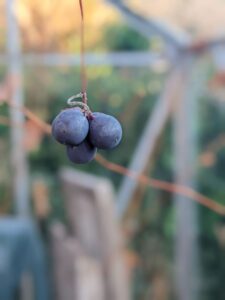
Black grapes for eating straight off the vine can be grown outside in the UK in a sheltered spot. They’re often sold as suitable for both dessert and wine use and need a warm sunny location with free-draining soil if you want to eat them freshly picked.
In cooler and northern regions they will need protection, usually a greenhouse. The roots can be outside which means the rain will provide water; whereas if the roots are inside, you’ll need to water the grapevine.
Hungarian Hawthorn
Crataegus nigra, Hungarian Hawthorn, Black Hawthorn, has green foliage like the familiar hedgerow shrub, Crataegus monogyna. But instead of red berries it has black, as do about 40 other Crataegus species. The Hungarian hawthorn berries are some of the darkest, and can be eaten raw or cooked.
Like our two native species, Hungarian Hawthorn tolerates most soils and locations. It’s good for a wildlife garden or as a hedging plant – the edible berries are a bonus!
Mulberry, Morus nigra
Black mulberry, also known as Morus nigra, is native to southwestern Asia but will grow happily in the UK. It prefers a moisture retentive soil and shelter from cold, dry winds and will grow to about 25 foot tall, with a spread of 20 foot.
As its difficult to find Mulberry fruit on sale, if you like them (as I do) then growing your own could be the solution if you have the space, although they can be trained against a wall. Black Mulberry fruits look like a large blackberry but they have a more delicate flavour.

Olives
Just because they’re not of sweet doesn’t mean they’re not fruits!
Black olives are not special olives. They’re simply olives that have been allowed to fully ripen on the tree before harvesting. Generally, unripe olives are green, whereas fully mature olives are black.
The olive tree, olea europaea, is for many of us the quintessential Mediterranean tree. But it is an adaptable and hardy tree suitable for growing in the UK. If you live in the southern and western areas of the UK, including some quite north-westerly coastal areas or within an urban heat island, grow it outside. Elsewhere it will be happy outside in the warmer months but need protection in a cold winter.
Pear, Black Worcester
Despite their name, Black Worcester Pears are not black but rich dark mahogany in colour. They are an historic culinary cultivar of the domestic pear, Pyrus communis.
Possibly introduced by the Romans, the Worcester Black Pear was first recorded by Warden Abbey in Bedfordshire in the 13th Century. It has been part of the Worcester coat of arms sine the 16th century.
I feel it’s a culinary pear which should be more widely grown as the tree is easy to look after and the fruit, harvested in late October stores until March. Loved growing it on my allotment and plan to add it to the orchard in my new garden. Thanks to dwarfing rootstock, it can also be grown in a container.

Plum, Black
Plums, Prunus domestica, grow well in the UK, and as long as you have a sunny spot you can grow them in the ground or in a container. Some, particularly Damsons and Bullace are often used as wind break trees around the edges of an orchard.
Black plums are usually described as those fruits which have both a dark skin and a dark flesh. For the purposes of finding cultivars which are easy to find in the UK, I’ve stuck with dark fleshed types. Plum ‘Black Amber’ is a dessert rather than a culinary variety, suitable for container growing as its partially self-fertile, whilst ‘Black Prince’ does need a pollinator.
13 Black fruits to grow for Halloween – and finally
Well, hopefully you’ve had a bit of fun finding ways to decorate your Halloween table. Or perhaps I’ve inspired you to look for some different fruits to grow in your garden or allotment. Either way, I hope you’ve enjoyed this weekend’s blog and the links below.
If you’d like to learn more about growing your own fruit – whether thats 13 Black fruits to grow for Halloween or not, why not have enjoy a gardening course with your own garden as the classroom? Plews Gardening Lessons make a good presents too…
For further gardening advice and inspiration, check out Plews Potting Shed blogs, including the selection below and our monthly Tipsheet – You could come and find us on Instagram Pinterest and Facebook too.
Related Gardening articles you may enjoy from our Award Winning Blog
Growing Your Own Fruit
How to have a Mini Orchard in Your Garden
Gooseberries – some Questions and Answers
Pruning the Greenhouse Grapevine
Cordon Apple Trees – Garden Surprises when Pruning
Michaelmas Daisies and Blackberries – Garden Folklore
Halloween Inspiration for Your Garden
Black Flowers for Your Spooky Garden
Halloween props – 5 Planting Ideas for Your Garden


