

Gardening on clay soil has both advantages and disadvantages. But clay soil gardens have the potential to be one of the most productive gardens for vegetables, fruit and ornamentals.
Clay soils, chalk soils and sandy soils all have a different soil texture. This soil texture cannot be altered as it based on the parent rock. It is the composition of the soil in terms of the particle size. Clay soils have the smallest particles and sand the largest. As a comparison, approximately a 1000 million clay particles are needed to make the same volume as one sand particle!
Gardening on Clay Soil
Gardening on clay soil has both advantages and disadvantages – and not all forms of clay are the same. For example, reddish clays usually have better aeration than blue/ grey clays. If you’re a bit nerdy (hands up, me too) you may find it interesting to check one of the interactive soil maps available online to discover both the dominant type of clay soil and the bedrock in the area in which you garden.
Checking or knowing what the underlying bedrock is, may help you to understand why your clay soil is slightly acid, say pH6, whilst a friend has clay soil in their garden which is slightly alkaline, say pH 8.
Disadvantages
- A clay soil does not drain well, which is why it gets waterlogged easily
- It is susceptible to damage when worked or walked on; when wet this can lead to compaction
- The small particles are the main reason why clay goes hard and cracks in drought conditions
- Clay soil warms up more slowly in spring than other soil types as it reacts slowly to temperature changes
- It is hard to dig, sticking to spades and boots when wet and coming up as large clods where the particles have stuck together
- Clay soil often dries out and cracks in summer

Advantages
- Most clay soils contain either high nutrient levels or the potential to be highly nutritious
- The addition of lime, Calcium carbonate, can aid the sticking together of clay particles to improve the soil structure. This is known as flocculation, or liming the soil. However, Calcium sulphate, Gypsum, is less likely than other forms of lime to alter the pH of the soil, so may be a better choice
- The addition of organic matter / humus / compost will also encourage the creation of these soil crumbs, or combination of soil particles
- A further benefit of organic matter is it improves the drainage of clay soils
Improving Clay Soils
Gardening on clay soil has traditionally meant a lot of digging and incorporating various other substances into it. But digging is not always the best option.

Digging
When the soil sticks to your spade and boots to the extent where there is more soil than spade, do not try to dig. You will compact and damage the soil structure. If you know that there is going to be rain in the days before you plan to dig, it may help to cover the soil so it stays relatively dry.
- Rough dig the area in autumn leaving the soil in coarse lumps to be further broken up by the action of frost over winter
- A fork is often better for digging clay soil than a spade
- On heavy clay soils, the addition of sharp river sand and or grit as well as organic matter will help speed up
- Consider double digging a new area, incorporating sand, grit, humus
No-dig
This may be your option for physical reasons, because you wish to pursue no-dig methods or perhaps because the area is large and you need to tackle it in stages.
It is a longer term plan, involving, for example, adding layers of organic matter, cardboard, grass clippings etc to gradually improve the top layers of the clay soil by the action of worms and decomposition. Perennial weeds should be removed first!

What to Grow in Gardens with Clay Soil
There is a wide range of plants available for those who are gardening on clay soil. And although soil is arguably the most important, it is worth remembering that there are other factors in keeping plants healthy. For example aspect, which is how much sun and shade different areas of the garden receive, as well as southerly, westerly etc.
Flowering Shrubs
The suggestions are in alphabetical order and between them will provide flowers for most of the year.
Abelia
Chaenomeles, ornamental quince
Honeysuckle
Hydrangea
Laburnum
Lilac, Syringa
Philadelphus, mock orange
Ribes, flowering currant
Roses
Weigela

Herbaceous Perennials
A list of what doesn’t grow in a clay soil may actually be shorter! This selection offers foliage interest as well as flowers over a long season.
Ajuga reptans
Aster, Michaelmas daisy
Bergenia
Foxglove, Digitalis
Gaura
Geranium
Helenium
Hosta
Japanese Anemone
Lychnis coronaria
Peony
Persicaria
Pulmonaria, lungwort
Sedum
Thalictrum

Annuals, Biennials, Bedding
Coreopsis
Forget-me-not
Petunia
Tagetes, French marigold

Bulbs, Corms, Tubers
Crocus
Galanthus, snowdrop
Bluebells, Hyacinthoides non scripta
Narcissus, Daffodil

Gardening on Clay Soil – the Kitchen Garden
Many vegetables prefer a clay soil, so it is arguably the best soil on which to start a kitchen garden.
However, if the clay is very heavy, then raised beds could be an ideal solution for the kitchen garden and vegetable plot. Raised beds are not always as practical in the ornamental parts of your garden, where borders are adjacent to a lawn. To avoid walking on the soil of raised vegetable beds, make them no wider than 1.2m -1.5m (4ft -5ft) wide beds. This way they can be reached from the sides, ie from the paths which have been created between them.
Either raised beds or improved soil will be necessary for growing early vegetables and for seed beds due to the coldness of clay soil.
Vegetables
Beans
Broccoli
Brussels sprouts Cabbage
Chard
Lettuce
Pak choi
Peas
Potatoes and Jerusalem artichoke will also help break up the soil. And, so long as the soil has been enriched with compost, squash will do well.
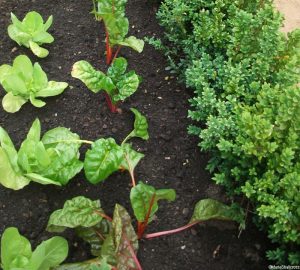
Fruit
Many tree fruits and bush fruits that will happily grow in clay gardens as they prefer a slightly acid pH.
Currants, including gooseberries, are tolerant of a clay soil.
Apples other than those on M9 (dwarf rootstock) will manage with heavier clay soils, although both apples and plums are best on a free draining clay soil.
Generally speaking the more dwarf or restricted the rootstock, the less able the fruit tree is to cope with a heavy, winter wet clay soil. Pears are more able to cope with damper soils over winter.
When gardening on clay soil it is crucial to improve the soil in the planting hole. The hole should be about twice the size of the root ball – width and depth so that the fruit trees and bushes get off to a good start. Be sure to mix the improved soil into that surrounding the hole so as not to create a pocket which will restrict the root growth. This should enable even peaches, olive and citrus to grow and crop on clay soils. Although they are still best planted in a free draining spot or on a slope.

Gardening on Clay Soil
Finally, if you have a choice, go for a garden with clay soil above any other. It is generally the easiest to turn into that elusive, fertile, friable ‘fine tilth’ much loved and dreamt of by gardeners throughout the ages. Although it will take time to get there or money to do it more quickly, it is worth it.
If you would like help with gardening on clay soil, a garden design or planting design do get in touch. Plews is able to offer you a Garden Consultancy Visit, Gardening Lessons, Garden Design and Planting Design to suit your needs. Please check out relevant pages on the website for more details
For further gardening tips and inspiration check out Plews Potting Shed blogs, including the selection below – and find us on Instagram and Facebook
Related Gardening Blogs for You from the Award Winning Plews Potting Shed
Soil
Soil – the plant food in your garden
Lasagna Gardening – Growing Methods for Gardeners
Soil Preparation – Double Digging
What is the Point of a Raised Garden Bed in the Vegetable Garden?
Plants
What is an Annual Plant?
Bluebells
Beautiful Apple Blossom Trees for Your Garden
Scented Roses, rose bushes, climbers, fragrant flowers
Growing Potatoes in Your Garden
9 Shrubs and Trees for Stunning Autumn Foliage


