

Shrubs and trees for stunning autumn foliage has suggestions for plants that will turn your autumn garden into a blaze of reds, yellows and bronze. So whether you have an informally planted cottage garden or a modern garden with a contemporary planting scheme, you should find a tree or shrub to suit your style and fill your autumn garden with colour.
Shrubs and Trees for Stunning Autumn Foliage on an Acid Soil
Many people worry about gardening on an acid soil, that is one with a pH of less than 7. However, when it comes to a stunning display of autumn leaf colour, there is no need to worry. Some of the best trees and shrubs for a display either actively need an acidic soil or are tolerant of it.
Acers
Of course, Acers, the Japanese Maples are prized for their autumn colour. They frequently have delicate dissected foliage and good foliage colour for three months of the year.
Acer Palmatum ‘Sango Kaku’, also known as coral-bark maple, has one of the best autumn foliage colours which turns yellow and is so attractive in winter with its coral red stems.

Enkianthus perulatus
This is a compact, deciduous shrub, that produces pretty white bell-shaped flowers in May. The leaves are a fresh green colour, before turning a brilliant red in autumn. It can also be clipped into neat shapes, or cloud pruned.
Cercidiphyllum japonicum
More commonly known as Katsura is a beautiful tree that can reach 30 metres. It’s usually but not guaranteed to be shorter in the British Isles, so if space is an issue try one of the smaller cultivars such as ‘Boyd’s Dwarf’ which only reaches 2 metres.
Pink flushed foliage in spring turns green an the n orange, yellow and red in autumn. But the best part is the caramel scent that wafts gently on the breeze.
Glorious autumn foliage – less fussy about soil acidity
Of course, there are many shrubs and trees for stunning autumn foliage that are less fussy about the acidity of the soil, so long as it’s nutritious and free draining. The following are some of my favourites which I’ve sued in garden designs and planting schemes over the years.
Cercis canadensis ‘Forest Pansy’
Also known as North American redbud this is a small tree grown for its beautiful foliage throughout the year. Heart shaped leaves emerge a vibrant ruby red in spring, darken to a rich purple during summer and in autumn they turn striking shades of orange, red, yellow and purple. Reaches 5 metres
Amelanchier lamarckii
Also known as snowy mespilus and Amelanchier canadensis, is a beautiful, small tree attractive in all seasons. The showy spring blossom is lightly scented, the berries are edible and in autumn, the yellow-green leaves turn scarlet and crimson. It will grow to 8 – 12 metres.

Liquidambar Styraciflua
Also known as the American Sweet gum and alligator tree, this tree has maple like leaves. It will eventually grow to about 15 metres, but if you have the room, its orange, crimson and purple shades of autumn are well worth the space in the garden.
Euonymus
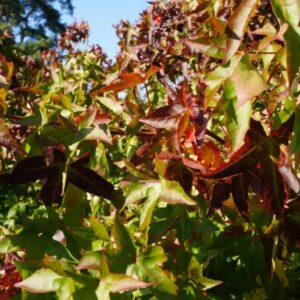
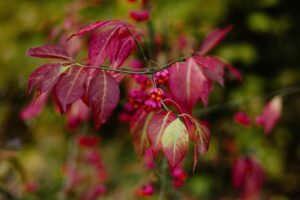
Both Euonymus Alatus and the British native Euonymus europaeus, the spindle tree have good autumn colour.
The foliage turns a dramatic shade of red, complementing the orange-pink winged fruit, which remain on the tree long after the leaves have fallen. They will tolerate most soils including lightly acidic.
Cornus Controversa Variegata
Also known as the Wedding Cake Tree. The spring and summer variegated green and cream foliage becomes a dramatic purple and red in autumn. This particular Cornus tree will reach 8 metres height, however, it has an attractive layered effect spreading branches so it is as wide as it is high.
Ginkgo biloba
This deciduous conifer has lovely fan shaped leaves that turn a lemon yellow in autumn. Although slender, it does get tall, 30 metres (after 100 years its true, but lets think ahead) You may prefer one of the dwarf forms such as Ginkgo biloba ‘Troll’ which grows slowly to around 1m tall.
Positioning your Shrubs and Trees for stunning autumn foliage effects
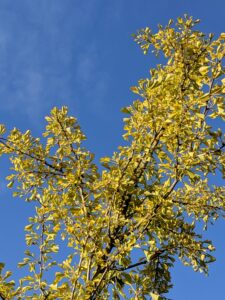
In order to get the maximum effect of these colourful leaves, you’ll need to positioning the plants where the sun can backlight the foliage. Now I would take this excellent but general recommendation one step further and suggest that you consider where you are most likely to view the shrubs from.
By which I mean, for example, if they’re placed to catch the morning sun you can sit with your elevenses and appreciate the translucent effect. Or it may be that the tree is planted in your front garden where the autumn evening sun shines through the leaves, welcoming you home with a glorious display of colour.

When you’re planting shrubs and trees for stunning autumn foliage also consider what is already planted in front of them or what could be added as part of the new planting design. For example, you could have a jewel like display of autumn foliage and late flowering perennials such as Dahlias and Heleniums.
For more planting ideas for colourful autumn gardens – and the answer to that perennial question that children ask “why do leaves fall?” have a read of the blogs below. If these merely whet your appetite, there are further links to planting ideas – and do please get in touch if you’d like Plews to create an autumn garden scheme to delight you year after year!
If you would like help with learning more about your garden and gardening, why not ask about our bespoke Gardening Lessons, where your classroom is actually your own garden. We can help you learn gardening basics, and also show you how to plan an ornamental border or kitchen garden.
And for further gardening advice and inspiration, ask for Plews monthly Tipsheet – You could come and find us on Instagram Pinterest and Facebook too.
Related Gardening articles you may enjoy from our Award Winning Blog
Autumn Colour in Your Garden
Planting Ideas for Colourful Autumn Borders
Garden Visits – Winkworth Arboretum
Why do leaves fall? And other Autumn Gardening Questions
6 Tips for Your Autumn Garden


