

How to sow seeds indoors gets down to the nitty, horticultural gritty of sowing, as promised in the previous Plews blog, Sowing Seeds Indoors (link is below).
That blog covered what you need and what you don’t in the way of sundries and equipment. Items you could recycle and ones you could buy.
This time we want to sow the seeds themselves. There is also a video at the end demonstrating how to sow different types and sizes of seed.
Indoor seed sowing is not just about where you are standing when sowing, but where the seed trays and pots will be until the seeds have germinated and at the very least, be big enough to transplant. Indoors includes greenhouses, polytunnels, cold frames, windowsills. Basically anywhere where you can give the newly sown seeds protection from the elements.
How to Sow Seeds Indoors – Growing media
The presumption is that you will not be growing hydroponically but using a more traditional growing media.
NB there are real health and safety reasons why you should not just wear gloves when handling soil, compost, etc but also be in a well ventilated space.
This is generally referred to as ‘compost’ or seed compost. Which can be confusing as ‘compost’ is the stuff made in compost bins and used to improve soil quality and offer up nutrients to give healthy plants. So I’ll call it growing media to save confusion.
What it isn’t, is garden soil. Whilst you can use garden soil indoors, because conditions and seed requirements are different, it’s not always the best choice. Part of this relates to the type of soil you have in your garden borders. For example a clay soil is slow to warm up in spring and can be extremely wet. Neither of these qualities are what seeds are ideally looking for. Mixing your garden soil with other ingredients, may help resolve some of the problem (see making your own seed compost below).
The growing media needed for sowing seeds doesn’t require much compost in its mix. Seeds within their shells have most of the nutrients they need for their initial growth. It’s more important to ensure that they don’t rot, so a growing media for seeds should be free draining.
You could use John Innes No 1, sometimes called seed compost. This is a tried & tested seed compost mix not a brand and is now available as peat-free. If the seed compost seems more generic check the bag for what is in it. Avoid those which have peat in them, unless it happens to be Moorland gold. This compost is made with ‘naturally filtrated peat’ that would otherwise be washed to the sea.
Gardening Teacher Tip
Are you concerned about how to sow seeds indoors when the plants they grow into need acid soil and your growing media is peat free?
Its okay. The seeds will generally be fine, its more about the seedlings that germinate. Most will manage as multipurpose potting compost is usually a neutral pH. And you can add sand to the mix which will help as this is acidic.
However, if you know about the acid loving plant seeds in advance, you could get some peat free ericaceous potting compost and mix grit in with it for drainage. Then the seedlings will also be fine until they’re large enough to transplant.

How to Sow Seeds Indoors – Make Your Own Seed Compost
Yes, you could make and mix your own growing media! To be effective, seed starting soil needs to be lightweight and drain extremely well. Nutrients are less critical until the seed has germinated. But as you won’t be transplanting as soon as that occurs, its best to include some nutrients into the mix.
Which elements you add is your choice but choose one from each column
| 2 parts | 1 parts | 1 parts |
| peat free multipurpose
| horticultural sand
horticultural grit vermiculite coir | horticultural sand
horticultural grit vermiculite
|
| garden soil
| enriched multipurpose
peat free multipurpose
| horticultural sand
horticultural grit vermiculite coir |
| coir | enriched multipurpose
peat free multipurpose | horticultural sand
horticultural grit vermiculite
|
| garden compost
soil improver enriched multipurpose | horticultural sand
horticultural grit vermiculite coir | horticultural sand
horticultural grit vermiculite
|
NB
- Smaller seeds especially need a fine seed compost, so be prepared to sieve coarse material and clumps. (Rubbing out large clumps with your gloved hands is okay!)
- Coir will open up a mix but may be too coarse for smaller seeds. It has no or very little nutritional value
- There are pros and cons about using garden soil, too many to discuss here. But I will suggest that clean soil could be considered an important factor.
For most seeds the ratio will be 2:1:1 (top row) For seeds that have a tendency to rot, or if you feel overwatering or a damp environment could be an issue, amend to 2:1:1.5
It doesn’t matter what scoop or jug you use to measure, so long as you use the same one for each. Mix ingredients together thoroughly. An uneven seed compost could lead to various issues, such as crowding and damping off.

perlite, vermiculite and horticultural grit
Seed Trays vs Modules and Pots
The question here is whether your seedlings can tolerate being transplanted (moved) from seed tray to a pot as a seedling. Or from seed tray straight outside as a larger seedling.
If that’s a yes, they can cope with some root disturbance, then you can use seed trays. But if it’s a no then you’ll need to sow the seeds in separate modules or pots.
There is another matter to consider and that is are the seeds pea or bean family members? Legumes or Fabaceae, including sweet pea flowers need a long root run and do best in tall pots or deep trays. They do best in these as their long roots can go down rather than across – it makes them more stable when you transplant outside.
For re-using and making your own pots, see blog links below.
How to sow seeds indoors – the size of seeds
Most seeds need light, air (oxygen) water and warmth to germinate. Basically, keep the growing media warm and damp, but not too damp. Then you can look forward to seeing those little green shoots which mean germination has occurred.
However, sometimes getting a better germination rate from your seeds starts with treating them in different way depending on their size.

Tiny seeds
Tiny seeds are easier to sow if you mix in a little fine sand with the seed. Then you can see how they’re distributed across the soil surface – in clumps or spaced out.
Sprinkling them from the packet may not be precise enough. I find that tipping a few onto my palm and using the lines on my hand to direct the seeds onto the surface of the compost works better.
Leave tiny seeds uncovered, or with only a shallow layer of grit, vermiculite or fine sand. This allows air & water to easily reach more delicate seeds.

Larger seeds
Rounded medium-large seeds include the onion family. These are easy to handle and sow in trays. Larger seeds such as sweet peas and beans can be placed in cells individually, or in twos or threes depending on the size of pot.
Large flat seeds
Such as those in the squash family and sunflowers. These benefit from being sown on their narrow sides in pots so that they don’t rot. Gently push them in and cover with more growing media.

wrong

right
How to sow seeds indoors video –
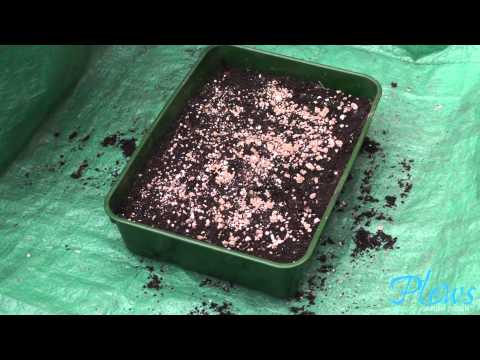
Read on if you prefer text and still pictures
How to Sow Seeds Indoors
Ready, steady, sow!
Get your seed tray ready; fill with growing media nearly to the top and give the whole thing a gentle shake to level the soil. Tap down lightly on the surface with another seed tray to get rid of any air pockets and give yourself a smooth surface.
Larger seeds can be held in your fingers and spaced out in the seed tray. Remember to allow enough room for each seed to germinate and develop roots as well as a shoot. They need to get to the first true leaves before being large enough to transplant. A zig zag pattern gives the optimum spacing.

If you’re sowing seeds into modules, have 1 -3 seeds per module.
For smaller seeds, you may find it easier to sow them in straight lines so you know where they should be. Tap your hand gently to get an even flow of seeds. If they don’t come out evenly, don’t worry too much. It may just be that you will have to thin them out after germination.
Place in a gravel tray (like a seed tray but without holes) so water is contained. Sprinkle over a layer of the growing media sufficient to cover the larger seeds. Leave the small ones uncovered. Water with a gentle spray. Add a clear lid if required for extra protection or moisture retention.

How to Sow Seeds Indoors – Keeping a Record
You may feel that labels are sufficient, and they may well be. But it doesn’t harm to also have a simple list of which seeds you sowed on a particular day. If nothing else it enables you to quickly check if they should be germinating. Germination can be 5 days to 2 weeks or longer, depending on the seeds.
And for the next stage – keeping your seedling healthy – we head to another blog!
and finally
Hopefully I’ve helped you with tips for how to sow seeds indoors. If the blog links and videos leave you hungry for more, you may like to consider a Plews Gardening Course, where we enjoy 1-2-1 practical sessions in your own garden. A mix of practical and theory (the “why we do things”) bespoke to you, your garden and what you want to learn. And we can transplant some of the sessions into 1-2-1 zoom calls.
For further gardening advice and inspiration, check out Plews Potting Shed blogs, including the selection below, and our monthly Tipsheet – You could come and find us on Instagram Pinterest and Facebook too.
Related Gardening articles you may enjoy from our Award Winning Blog
Sowing Seeds Indoors – what you need and what you don’t
Peat free compost – are you still confused?
10 Tips for Saving on Garden Essentials
What Might a Plews Gardening Lesson Be Like?
Ten tips for Successful Seed Shopping
Plews eBooks


