

Doves and dovecotes – the link to your garden, or to a large, country house garden is obvious. But what might be the link to Saints, in particular Saint David, the patron saint of Wales?
Now Saint David’s Day falls on March 1st, and many of you will be aware of the saint’s connection with leeks. Possibly there’s a few Shakespeare buffs amongst you who can recollect a scene involving leeks in the play Henry V. And, of course, our spring flowering native daffodil, Narcissus pseudonarcissus, also belongs to Saint David. You can read suggestions for daffodils to enjoy in your garden, and how to grow leeks in the links at the foot of the page. But first, let’s have a look-see at why Saint David also has a dove as one of his symbols and then move onto doves in the garden – be they birds or flowers…
Saint David and a Miracle
He is frequently represented as standing on a hill with a dove resting on his left shoulder, obviously preaching to a crowd of people. The legend explaining that image is as follows. Saint David was preaching in the middle of a large crowd and couldn’t be seen. But then a miracle happened: a hill rose under the saint’s feet and then he could be seen by everyone. And more – a white dove alighted on his shoulder as he addressed the crowd around him.
Doves and Dovecotes – Romance and Larder
It has long been a wish of mine to have a few doves and a dovecote in my garden. I’ve kept hens, but they are altogether a different sort of bird. None the less enjoyable, but different. Prosaic perhaps, rather than romantic.
And equally I’ve been fascinated by the many styles of dovecotes. Solid, historical ones of stone, small, modern wooden ones. Dovecotes with a room below. Dovecotes which are really something else – like a water tower perhaps.
These days we have a tendency to consider doves and dovecotes from a romantic perspective. And why shouldn’t we? A pair of white, fantailed doves cooing on the perch of a small dovecote whilst nearby lovers sit under an arbour of scented white roses offers a pretty scene for Valentine’s Day and beyond, encapsulating an important element of romantic garden design.
However, historically, whilst the romance of doves has been a part of literary tradition since the Middle Ages, it wasn’t their prime function in the garden.
A Few Facts about Doves and Dovecotes
Dovecotes are believed to have originated in the Middle East where dove dung was used in quantity as fertilizer for crops.
Doves were possibly brought to Britain by the Romans, who certainly kept doves in dovecotes, called columbaria.
Medieval dovecotes were mainly found in wealthy noble households and in monasteries. The peasantry had to make do with catching woodpigeons. Which had the advantage of being a form of pest control.
Columba livia is the rock dove and a tunnel dweller. It seems this dove was the main progenitor for domestic doves, as it easily took to living in the stone and wooden dovecotes.
Dovecotes were effectively the battery hen coops of their times.
Once domesticated, the doves provided a regular source of food. Eggs, of course. But a pair of doves could provide young birds, squabs, every few weeks over the warmer months. These were tender to eat and highly prized.
And of course doves and pigeons provided fertiliser for gardens and farms. Pigeon dung gets a mention in thirteenth century texts as useful addition to the productive monastic gardens.
From the late eighteenth century, the Napoleonic Wars brought a need for the increased production of wheat and more profitable forms of meat. Dovecotes were kept by landed gentry for their own pleasure. They had never been a main source of protein for the general population, but ceased to be an economic option where profit margins were a factor.
Many dovecotes became romantic ruins, or were used for other means, such as grain stores. And cooing white doves in smaller dovecotes enhanced romantic garden styles.

Plants named after Doves
Interestingly for a bird who has been such a large part of romantic literature over the centuries, there are not as many plants and flowers called dove as you might expect. Here are just five: –
Davidia involucrata
A deciduous tree with beautiful, flowing white bracts surrounding a small dark flower. And its these bracts that have led to its common names of the dove tree, handkerchief tree and ghost tree. Tolerant of most soils, sun and partial shade, it grows to about 15 m with spreading branches. A pretty addition if you have the room for it.

Habenaria radiata
An exotic terrestrial orchid which is nevertheless hardy down to minus 5. Probably best kept in a cool conservatory. Commonly known as the egret orchid or dove orchid as the fragrant white flowers look like these birds in flight.

Geranium robertianum
This is a British native species and sometimes considered a weed as it does have a tendency to self seed. Known as Herb Robert, another of its common names is dove’s foot’, due to the shape of the leaves. Although the pink flowered form is more usually seen, there is a white cultivar, called appropriately for this blog, ‘Celtic White’.


Geranium molle
Another British wild flower, also known dove’s foot cranesbill (2 birds in 1 plant!) You may have found it in your lawn if its dry rather than soggy as it is a ground hugger. With a different leaf to herb Robert I enjoy seeing both in my garden, as they’re useful flowering plants for difficult spots such as under shrubs.

Aquilegia
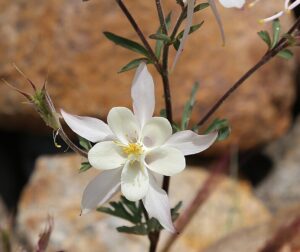
Thought this one might surprise you! These herbaceous plants are also known as columbines. They got that name for the flower’s resemblance to a circle of doves, feeding from a dish between them, Columba being the Latin for Doves. If you wanted to really get that look, then grow white flowered Aquilegia vulgaris. It is of course a stalwart of cottage gardens, but can look very chic in the centre of a steel planter surrounded by white striped Hosta.
And finally
As for me, I’m still waiting a white dove to appear in my garden with her mate. One should have dreams to aim for, it helps keep you sane when you count nine pigeons fighting for possession of the bird feeder…
This blog – doves and dovecotes, saints and flowers – was written to entertain you, and I hope I’ve succeeded. But you may have also been inspired to grow these citrus fruits for yourself. Helpfully, I’ve already written a blog on that – see below. And if you’d like a garden design created with pots of oranges and lemons on the terrace, do get in touch.
Or why not ask about our bespoke Gardening Lessons, where your classroom is actually your own garden? You could learn how to grow an orchard of citrus fruits in your conservatory. We can help with both gardening basics and more ‘expert tasks’, carry out worm and other experiments and for example, also show you how to plan a vegetable plot. Have a read through this pdf download for info. And if you prefer company, there are small group Gardening Workshops to come to.
For further gardening advice and inspiration, check out Plews Potting Shed blogs, including the selection below Plus we have a monthly Tipsheet You could come and find us on Instagram Pinterest and Facebook too.
Feeling nosey? You can have a peek at the progress of my garden renovation, Spitfires and Slow Worms, on Instagram and Facebook
You’ll get to see it in person if you come to the Plews Gardening Workshops Although later dates and topics still need to be finalised, there are already a few up on Eventbrite for you to book into. Follow for updates on topics and dates on Instagram, Eventbrite, Facebook
Related Gardening articles you may enjoy from our Award Winning Blog
St Davids Day – Leeks & Daffodils – Growing Tips & Design Ideas
Garden Design Inspiration – Daffodils, Leeks, Dragons, St Davids Day
Leeks for St David’s Day, History and Growing Tips
How to Grow Onions – and a bit of Onion History
Types of Daffodils which one is which!
Dwarf Daffodils for Spring Colour
Daffodil Fact and Fiction plus Planting Ideas
And doves in the garden!


