

The phrase ‘types of daffodils’ refers to the way in which similar Narcissus are grouped together. Properly referred to as ‘divisions’ when growing and showing Narcissus, it is nevertheless a helpful means by which us lesser mortals can choose which style of daffodil flowers most appeal to us.
For example, do you find yourself drawn to big flowered daffodils with one bloom per stem? Or smaller plants with many flowers on a single stem? And isn’t it fun to occasionally show off your knowledge to others and blithely comment to visitors admiring your spring display that you prefer jonquil to bulbocodium types? It can also make bulb purchasing easier as the divisions are often referred to in bulb catalogues.
Whether you have a thirst for knowledge, would like to show daffodils or are simply curious as to how many types there are, I have compiled a brief compendium for you. Read on, and yes, there are pictures and a few fun facts to further enlighten and entertain you too.
Firstly…
These daffodil divisions are the British ones, as per the Royal Horticultural Society; the Daffodil Society of Great Britain (established 1898) uses the same classification. However the American Daffodil Society (established 1954) uses virtually the same criteria. There are close links between the British and American societies, not least in recognising, registering and keeping records of new cultivars.
RHS System of Classification for the Different Types of Daffodils
Yes, the botanical Latin for daffodil is Narcissus but the common name is the one which is used when describing the classification groups. The cultivars do use the Latin name.
There are thirteen divisions, or categories, of daffodil. All the cultivars and garden hybrids belong in divisions 1 – 12. Division 13 is for those only known by their botanical name. (this becomes clear when we get there).
There is also a further classification, where daffodils are divided by the size of the flower when flattened out. This will be either miniature, sometimes called dwarf or intermediate.
Miniature or dwarf daffodils have flowers that are up to 50 mm in diameter.
Intermediate daffodils have flowers that are between 51 and 80 mm in diameter.

Parts of a daffodil flower
The essential names of parts to remember when working out which division a daffodil should be in are the corona and perianth.
Corona refers to the trumpet or cup, ie the central part of the flower. The different types of daffodils have varying sizes of corona and it may be referred to as corona, trumpet or cup in a description. Occasionally you may hear thimble or disc used, depending on the size of the corona.
Perianth refers to the outer part of the flower, the bit most of us think of as the petals. They may be referred to as perianth, perianth segments, petals, tepals or sepals. This is basically the non-reproductive part of the flower. Botanically speaking, Narcissi have perianth segments or tepals, but if you remember perianth then descriptions will become easy to understand.
Two other useful descriptive terms for distinguishing types of daffodils include pedicel and reflexed.
Pedicel refers to the neck of the daffodil flower where it joins the stem.
Reflexed is used to describe the way in which the perianth segments are swept backwards. Spreading is the term used when petals are open but not reflexed.
And lastly, rimmed daffodils are those which display a distinct band of colour at the corona rim which is different from the rest of the corona.
Different Types of Daffodils – the Official Divisions
Division 1 Trumpet Daffodil Cultivars
One flower to a stem. The corona is as long as, or longer than, the perianth.

Narcissus ‘King Alfred’
Division 2 Large-cupped Daffodil Cultivars
One flower to a stem. The corona is shorter than the perianth, but it must still be more than one-third of the length of the segments.

Division 3 Small-cupped Daffodil Cultivars
One flower to a stem. A smaller corona than the previous two and which is a third or less than the length of the perianth.

Division 4 Double Daffodil Cultivars
A ‘ruffled’ appearance, with one or more flowers to a stem. There should be a doubling of the perianth segments or the corona or both. Often there is little distinction between cup and petals.

Narcissus ‘Sir Winston Churchill’ a fragrant double daffodil
Division 5 Triandrus Daffodil Cultivars
Small flowered daffodils, exhibiting characteristics of Narcissus triandrus. There will be two – five pendant flowers per stem and the perianth segments are generally reflexed.

Division 6 Cyclamineus Daffodil Cultivars
The characteristics of Narcissus cyclamineus should be clearly evident. One flower to a stem with perianth segments significantly reflexed. The flower should be held at an acute angle to the stem and have a very short pedicel.

Division 7 Jonquilla and Apodanthus Daffodil Cultivars
These are the most fragrant daffodils. One to five flowers to a stem with perianth segments spreading or reflexed. The corona may be cup, funnel shaped or flared and is usually wider than it is long.

Division 8 Tazetta Daffodil Cultivars
These types of daffodils have three to twenty flowers to a stout stem. Other characteristics include broad leaves and spreading, but not reflexed, perianth. The flowers are often fragrant. NB: not all of the Tazetta daffodil cultivars are hardy.

Paperwhite daffodils, Narcissus papyraceus, popular for forcing for Christmas, fall into this division.
Division 9 Poeticus Daffodil Cultivars
Perianth segments pure white and the corona is very short, often disc shaped. It should not be more than one fifth the length of the perianth. The corona usually has a green and or/yellow centre with a red rim. Poeticus flowers are fragrant.

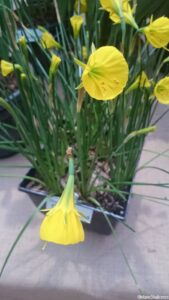
Division 10 Bulbocodium Daffodil Cultivars
These usually have one flower to a stem. The perianth is insignificant compared with the corona, which is bulbous or shaped like a hoop petticoat.
Division 11 Split Corona Daffodil Cultivars
The corona is usually split for more than half its length. Sub-divided into a & b types: Collar and Papillon
- a) Collar Daffodils
These have corona segments opposite the perianth segments. The corona segments are usually in two whorls of three, giving an orchid-like appearance.

Narcissus ‘Orangery’
- b) Papillon Daffodils
These have the corona segments alternate to the perianth segments. The corona segments are usually in a single whorl of six, giving a flatter more open face than collar daffodils.

Narcissus ‘Mondragon’
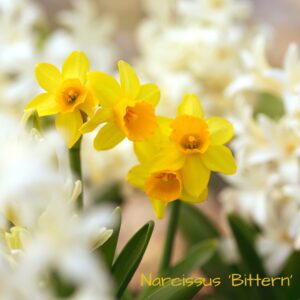
Division 12 Other / Miscellaneous Daffodil Cultivars
These are the daffodil cultivars which do not fit the definition of any other division.
Division 13 Daffodils Distinguished Solely by Botanical Name
These are the species daffodils, wild Narcissi and reputedly wild variants and hybrids.

Narcissus pseudonarcissus, wild daffodil
Daffodil Colours
Whilst the types of daffodils are predominantly classified by their shape and size, we also choose which ones to grow in our garden by colour. So I thought it might be of interest to quickly tell you how that is classified too. And it may be relevant if you want to exhibit daffodils at a local show.
As we already know, there are two distinct parts to a daffodil flower, the perianth and the corona. These may be the same or different colours and a two letter code is used to describe this, separated by a hyphen.
As there are a limited number of colours its easy to work out. Perianths come in yellow (Y), white (W), and orange (O). The perianth colour is named first. Corona use these colours, plus pink (P), red (R), and green (G).
Most daffodils only need two letters to describe their colour. For example, Narcisssus crewenna below is W-Y

Some types of daffodils, poeticus for example, have multi-coloured corona. This tends to be in helpful concentric zones, as here, with green at the bottom, then yellow, with a red rim at the top. This is written as GYR without hyphens, to indicate zonation within the corona. That full colour description for this poeticus would be W-GYR.
NB
Where the class in which you’re exhibiting requires the blooms to be a particular colour, it needs to be predominantly but not exclusively that colour.
5 Daffodil Fun Facts
- There are about 40 species of daffodils, but probably 200 if you include sub-species. Plus there are over 27,000 registered hybrids.
- Narcissus Poeticus is known as the pheasants eye daffodil for the red ring on the rim of the corona which mimics the bird’s eye.
- It’s also known as the poet’s daffodil. But they were not Wordworth’s daffodils, the host of golden daffodils was Narcissus pseudonarcissus, the British native.
- Deer, rabbits, squirrels, foxes and rodents don’t eat Narcissus bulbs. Often squirrels seem to be digging up daffodils, when really they’re planting acorns and chestnuts.
- Daffodil bulbs are long lived and can easily outlast the gardener who planted them.
and finally…
Hopefully, I’ve inspired you to grow all the different types of daffodils in your garden. And you may like to think about exhibiting some at your local flower show. This can be great fun and you’ll find the garden club members helpful and supportive of newcomers.
Of course if you’d like some personal help with a planting design for a mixed ornamental border of bulbs, herbaceous perennials and shrubs filled with colour and bees year round, then do please get in touch to ask about our design and consultancy services.
For further gardening advice and inspiration, check out Plews Potting Shed blogs, including the selection below and our monthly Tipsheet – You could come and find us on Instagram Pinterest and Facebook too.
If you’d prefer hands-on personal help from yours truly to learn more about your garden and gardening, why not ask about our bespoke Gardening Lessons, where your classroom is actually your own garden. We can help you learn gardening basics, and also show you how to plan an ornamental border or kitchen garden. Have a read through this pdf download for info
And you can have a peek at the progress of my garden renovation, Spitfires and Slow Worms, on Instagram and Facebook You may even get to see it in person early 2025 as I’m planning a couple of workshops. I had hoped to do that already but house renovations have been as big a thing as garden reno so there hasn’t been the room. Keep an eye on the website and social media for an update.
Related Gardening articles you may enjoy from our Award Winning Blog
Daffodils
Dwarf Daffodils for Spring Colour
How to Enjoy Spring Flowering Bulbs
Daffodil Fact and Fiction plus Planting Ideas
Gardens and Gardeners
A Week in the Life of a Gardener’s Spouse
5 Favourite Mothers Day Flowers in your Garden
6 Rabbit proof plants (other than Daffodils)


