

2016 is #CB300 Year – in honour of Lancelot ‘Capability’ Brown.
Capability Brown was the leading landscape gardener of his age. Tradition has it that he got his nickname from telling his rich and noble clients that he could see the ‘capability’ for development in their country estates.
An English Heritage blue plaque can be found at Wilderness House, in the Wilderness Garden in the grounds of Hampton Court Palace. Brown was appointed Master Gardener at the Palace in 1764. By Royal Appointment always sounds good on a chap’s CV and it undoubtedly helped his career.
He lived here until his death in 1783. Hampton Court Palace gardens does not seem to have made any significant changes to the gardens. For example, the formal gardens created by George Loudon and Henry Wise were not swept away to give a vista of the River Thames. Which is probably just as well, as they are stunning and important gardens created by two other famous and talented garden designers and landscape gardeners.
More than 260 sites in England and Wales have been attributed to Brown, although they have not all been clearly identified. Some may have been ‘in the style of’ and inspired by Capability Brown rather than designed by the man himself. There are still about 150 which are worth visiting today, showing the style and ethos of the landscape garden movement. Some suggestions are listed below, with links to a full list.
Although famous – and infamous – in his day and in the years since as a landscape gardener, or landscape architect, Capability Brown wasn’t the world’s greatest plantsman. So despite his position as Master Gardener at Hampton Court, Brown’s planting list for his many clients was limited in its range. He is noted for including Cedar of Lebanon in all of his landscape designs.
What defines a Capability Brown landscape?
He developed a distinctive style of landscape architecture rather than an imitation of nature. However, Brown’s parks did not appear out of nowhere, they were a continuation of the Arcadian tradition. This had begun earlier in the eighteenth century, notably by landscape architects and gardeners Charles Bridgeman and William Kent.
The Arcadian landscapes sought to recreate elements of idealized classical sceneries and were partly a result of the influence of the Grand Tour. Arcadian style parks were created to complement and surround newly built Palladian style great houses.

Capability Brown’s landscapes look natural, with open expanses of turf and irregularly scattered with individual trees and clumps of trees. It was also part of Brown’s vision that this naturalistic landscape park should look maintained, or tended by the armies of estate workers that his wealthy clients employed.
Ha-has – a ditch to allow an unspoiled view from the house or terrace towards the parkland beyond are seen as typical Brown statement. However, it was his predecessor, William Kent, who first came up with the idea of a ha-ha, to keep the livestock out of the gardens near the house.
Formal walled gardens were frequently removed from their proximity to the great house to an area further away. The idea being that an unsullied view of the surrounding parkland was more important.
Serpentine paths lead to panoramic views and pastoral scenes. Straight lines were abhorred. Many avenues of trees that had been planted as part of the formal style of gardening were rooted out. They were replaced with loose groupings of trees.
Brown used both native species and exotic, or imported trees in his landscape designs. American plane trees and weeping willows were both popular exotic species used by him. But Capability Brown’s signature tree is surely the Cedar of Lebanon. A beautiful tree with an elegant shape that improves as the tree matures.
Great lakes were another key design feature of a Brownian landscape. These huge mirrors of water reflect the clumps of trees, stone bridges and sloping parkland to great effect. As with his serpentine paths, curved edges were critical to the design of the lakes, to give the natural effect.
Capability Brown Parks and Gardens
Brown was born at Kirkharle, Northumbria in 1716. It was here that he began work as a gardener, leaving for Southern England in 1739.
The dates given below are for the start of the commission; in many cases work went on for some years. Not least because of the feats of engineering that were required to create new huge lakes and plant large mature trees with very little in the way of machinery.
Stowe
Brown’s first ‘real’ commission; he became head gardener and clerk of works in 1741. His development of the Park, notably the Grecian Valley, continued the earlier landscape creation by Charles Bridgeman and John Vanbrugh during 1714-20 and William Kent from 1734-39.
Petworth Park
His work here included moving the original road from Petworth to Tillington which ran only fifty feet from the house. 1750

Trentham Estate
Major restoration is being currently being carried out to restore the Brownian landscapes. A wildflower meadow overlooking his lake has been in bloom this year in celebration of #CB300. 1759
Blenheim
Where Brown hugely increased the area of the lakes which set off Vanbrugh’s bridge to perfection. 1763
Syon House, 1754 and Alnwick, 1769
Both for the Duke of Northumberland
Longleat
An exhibition here shows how Brown swept away the late seventeenth century formal gardens created by George London. You even get the chance to vote as to whether Capability Brown was a vandal for destroying beautiful gardens, or a man with a vision of landscapes to inspire a love of nature. Appropriately, donations go to the Tree Council. 1757
Croome Court
This is one of the largest of his early landscaping undertakings. 1751
Knowlsey
Where Brown, in order to feed the water gardens, flooded a 62-acre lake. 1775
Sheffield Park
In keeping with the garden designer’s love of odd numbers, oaks were planted in groups of threes and fives. The ground was cleared around the base so as not to obscure views of the parkland. 1769
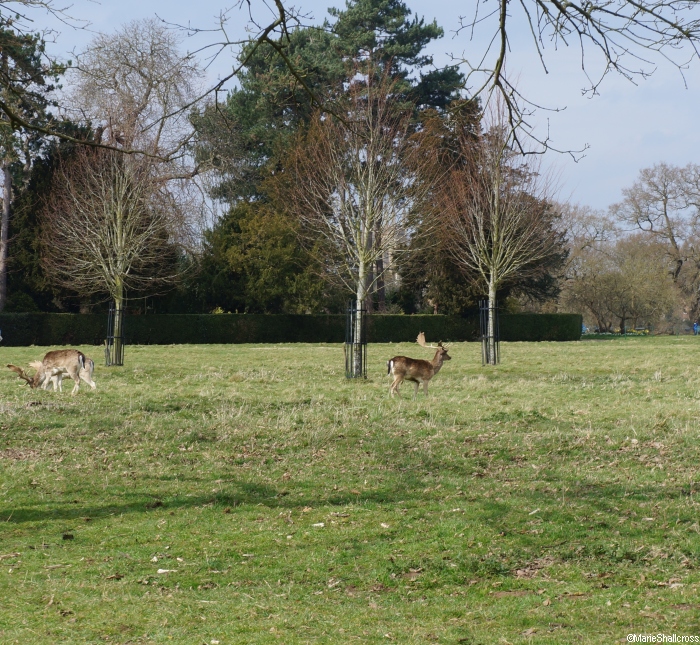
Charlecote Park
Originally a sixteenth-century deer park, it was substantially redesigned by Brown from 1757. The romantics of the nineteenth century saw this landscape as a fitting place for Shakespeare to have been caught chasing deer – the catalyst in his leaving for London and becoming a famous playwright.
2016 also celebrates 400 years since Shakespeare’s death. His plays have, among other things, inspired garden designs and planting designs – Plews blog links are below.
Chatsworth
Brown transformed the parkland at Chatsworth out of what was then working farmland. 1758
For a full list, check out the Capability Brown website
#CB300 – Capability Brown 2016 and Beyond
One of the delights of seeing the mature landscape of a Brown designed park during September is the glory of the autumn foliage turning a green landscape into glorious technicolour.
Although there are extra exhibitions and events for this tercentenary year, all of the parks are worth visiting in any year.
Related Gardening articles you may enjoy from our Award Winning Blog
Garden Visits – Historic Gardens of Hampton Court
Garden Visits – Winkworth Arboretum
Shakespeare – Midsummer Nights Dream – Garden Design Inspiration
Shakespeare – The Winters Tale – Garden Design Inspiration


