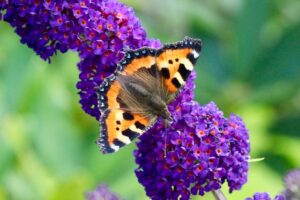
Why am I posing the question: Buddleia – Butterfly Bush or Beast?
Because there is a lot of conflicting information out there and I’m guessing my clients aren’t the only confused gardeners and would be gardeners.
Buddleia is considered an easy maintenance garden plant, a wildlife friendly shrub and a potential invasive species. It is no wonder that many gardeners are confused! Let’s see if we can add a bit of clarity to the Buddleia question …
A Bit about Buddleia
- To begin with – the spelling. Buddlea is also spelt Buddleja and Buddlea – and all are correct.
- There are over 100 evergreen, semi-evergreen and deciduous shrubs, and even a few herbaceous perennials and climbers among the mix.
- It is not native to the British Isles, the earliest species was introduced in the mid eighteenth century.
- Buddleja species originate in Asia, Africa and the Americas.
- The Genus was posthumously named ‘Buddleja’ after the Reverend Adam Buddle, a Botanist.
- Buddleia davidii is named after two clergymen – the other being Pere David (of Deer and Panda fame) who found the shrub in China
- It is a good shrub for seaside gardens or where the soil is poor

Buddleia davidii – the Original Butterfly Bush
Buddleia davidii is the most often found type of the Butterfly Bush found in British gardens and has been widely planted wildlife gardens for it’s nectar rich flowers. And it is this species with its many cultivars that could also be named a ‘beast’. Considered to be an invasive species in certain states in the USA, it has the ability to rapidly colonise areas, particularly waste grounds.
In Britain Buddleia davidii was one of the first inhabitants of bomb sites in World War Two, along with pink flowered Rosebay Willowherb, Chamerion angustifolium. (This latter being a plant species native to Britain). And it was the ability of Buddleia to take over areas such as railway embankments that have turned it into a perennial nuisance. Left unpruned, the winged seeds disperse and can travel a 100 metres or further, carried by the wind. Which is one reason why you’ll find Buddleja on roofs where there wasn’t supposed to be a garden!
Despite its proclivity to spread where its not always wanted, Buddleia davidii is not on the UK nor EU lists of invasive species.
And the many cultivars of this particular species of Buddleia are the shrub that we think of when someone says ‘butterfly bush’. They make excellent garden plants as well as providing food for wildlife. And among the cultivars are some with sterile seeds, which gets around the issues of seed dispersal of course.

Tips for Buddleia Care
It should be noted at this point that Buddleia seeds are not actually ripe until the spring after flowering. So any seed heads that you may have missed can be removed when you give the shrub a late winter / early spring prune.
The care notes Plews gives to clients who have had a butterfly bush included in their planting design has a easy maintenance schedule that I ‘ll repeat here. We recommend: –
- dead heading during the blooming season to encourage more fragrant flowers for humans and wildlife
- pruning off the main flowering stems in autumn
- remove any fallen spent seedheads
- a hard prune in late winter or early spring to encourage fresh new growth to bloom that summer
5 Buddleia davidii Cultivars Worthy of Your Garden
Unless stated otherwise, these are medium sized shrubs, growing to about 3 – 4 metres, with a bushy habit. They can be kept to a smaller size with a good pruning regime, for example, hard pruning in early spring.
Black Knight – with long panicles of dark purple flowers

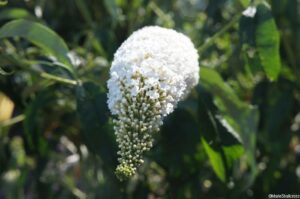
White Cloud – pure white flowers
Fascinating – has vivid lilac pink flowers
Santana – also known as Buddleia davidii ‘Thia’; variegated leaves, green edged with golden yellow; rich purple-red flowers

Harlequin – also known as Buddleja davidii ‘Royal Red Variegated’ or ‘Variegated Royal Red’; variegated leaves, green edged with creamy white; small purple-red flowers
A Few Butterfly Bush Alternatives
Well, actually they are still Buddleja, just not Buddleia davidii. They are still attractive to butterflies, moths and bees. Plus they have both wildlife garden ‘cred’ and would be a decorative, scented addition to your ornamental gardens. Although not the same butterfly magnet as the eponymous Butterfly bush, they are still attractive additions to a wildlife garden as well as shrub border.
Buddleia globosa
Buddleia globosa, also called the orange ball tree for it pom-pom flowers, does not look like the ‘usual’ Buddleia. Native to South America it was introduced into Britain in 1774, and was probably the butterfly bush Linnaeus had in mind when he named the Genus after Reverend Buddle. Another deciduous shrub, the flowers, arguably less fragrant than many other Buddleia, bloom in early rather than late summer.
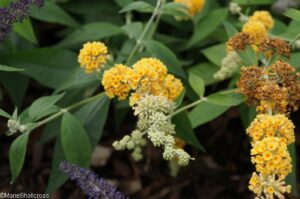
Buddleja x weyeriana looks similar to B. globosa but the foliage is grey-green. The flowers form less obvious spheres and bloom in mid summer. If you need a splash of orange from an easy care shrub, you could do worse than to grow both of them.
Buddleia colvilei ‘Kewensis’
A large shrub, with rich red flowers. Unlike most Buddleja, it will need some frost protection until mature and can be vigorous in growth so be ready to prune if you’re short on space.
Buddleia alternifolia
An unusual Buddleja as the leaves grow alternately on the stem rather than opposite each other. The leaves are an attractive dark green, showing off the fragrant lilac flowers rather nicely. It is a large shrub, so you may prefer
Buddleia alternifolia ‘Argentea’. This is smaller in habit than the species and has a slivery sheen to the leaves.
Butterfly Bush – Invasive weed or wildlife friendly?
We’re back to my original question: Buddleia – Butterfly Bush or Beast? My personal opinion? It’s a bit of both.
Buddleia davidii was swift to naturalise outside gardens once it had the opportunity. That in itself doesn’t make it a beast. Some would argue that whilst it is an excellent food source for many butterflies and day flying moths, it doesn’t provide sustenance for their caterpillar stage. But this is true of other plants. And surely no-one would plant a single species and consider they had a fully fledged wildlife garden?
Richard Mabey (writer, naturalist) is oft quoted as having frequently seen numerous butterflies of ten different species feeding away on his Buddlea. And the Butterfly Conservation Trust still recommend planting it in wildlife gardens (with a similar care regime to that I use) along with other plants to provide a well-rounded habitat. However, they do quite rightly advise against planting Buddleia davidii where it may be unmanaged and pose a risk to nearby wildlife habitats.

Conclusion?
Buddleia davidii can be easily managed as part of our garden tasks. Or we can grow sterile and non-invasive Buddleia species and cultivars. Which will of course still need to be pruned: a garden is a managed environment after all.
But which ever shrubs we choose to grow, let us enjoy the sweet, honey scent of the Butterfly Bush and watch the kaleidoscope of butterfly wings as the insects feed.
For help with creating your own butterfly pleasure ground and wildlife friendly patch, why not contact Plews for a garden design? Or you may prefer a garden coaching course to learn more about buddleia, butterflies and how to garden sustainably.
And do have a read of the articles below for ideas and information
Related Gardening articles you may enjoy from our Award Winning Blog
Flowering Shrubs
Flowering shrubs for Late Summer Colour
Chimonanthus praecox – Wintersweet
Cornus – Dogwood – Colourful Winter Stems
Scented Roses, rose bushes, climbers, fragrant flowers
Wildlife Gardening
Is Ivy Weed or Wildlife Habitat?
Creating Small Wildlife Habitats in Your Garden
Why Do Bees Like Purple Flowers?
Plants for Bugs – Wildlife Gardening