

Going on a Nematode Factory Visit was distinctly different to the usual Garden Visiting I do! Researching for gardening articles, blogs for Plews Potting Shed, garnering design inspiration for gardens and planting schemes is always enjoyable. But this factory tour was more than fun, it was also fascinating and enlightening.
I shall try to give you a taste of the mysteries of Nematode production. And explain what Nematodes are and do, just in case you weren’t sure!
What are Nematodes?
They are probably the most numerous multi cellular organism on earth. (Multi cellular as distinct from, for example, single cell organisms such as yeast and certain fungi). Over 20,000 species have been identified so far, with many thousands still unclassified.
So what? You may be thinking. Well, if you’re reading this on your phone or tablet, get your hand trowel and go into the garden. Scoop up a trowel-ful of soil. You may find a worm, but what you will have, unseen, is thousands of microscopic nematodes.
However, what you won’t know is whether those nematodes are helping control the garden pests that are attacking your fruit, vegetables and flowers.
Which is where the commercially available nematodes come in. These tiny creatures, parasitic worms if you will, are species specific. This makes them a highly useful weapon in the gardeners armoury as they will attack slugs, gooseberry sawfly, etc but leave unharmed the ladybird larvae.
You purchase a tub of what looks like putty, or halva, in colour and texture, although not in smell. It arrives through the post and you pop it into the fridge until the weekend, when you’ll use it as organic pest control.
But how did microscopic worms turn into a paste you water into your garden soil?

Nematode Factory Visit
This could be subtitled “Learning how to control Garden Pests organically with science”. It was a fascinating experience into the world of gleaming steel and white coats. All there to prevent slugs, chafer grubs (and more) from eating your Hosta, your lettuces and your lawn.
Externally, BASF’s nematode factory in Littlehampton gives little away of the secrets inside. It could house anything vaguely industrial: modular construction, a dearth of ground floor windows and surrounded by similar premises.
Internally it’s a whole different story. Over the last few years BASF has invested heavily in new equipment to improve the production process. This is now the largest specialist nematode production facility in the world and the only one in Britain.
Firstly we all had to get togged up in PPE gear – I’m not convinced orange is my colour…
We were split into two groups. The other one went off to the laboratories, which is where the process actually begins. But I’m going to follow this as I experienced it, beginning part way through, which arguably gave it a sense of adventure.
First impression? It was like a school chemistry lab on parents’ evening gone mad crossed with visits to breweries. The yeasty aroma made my nose twitch.
Wonderful.
First sighting of nematodes was in a solution in flasks jiggling about as if on a dance floor like embarrassed grandparents at a wedding trying to do the twist with arthritic hips.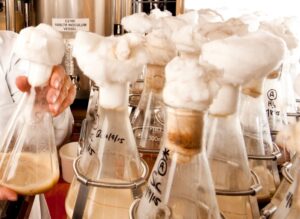
On a more scientific note, there’s a batch of nematodes in each of these flasks. The different species of nematodes are kept separate and although most of the soupy solutions are putty coloured, chafer grub nematodes colour theirs terracotta.
Preventing infection is vital. If the terracotta solution turns pink then its infected.
The Tour Continues
Once sufficiently mature, the flask solutions are used to seed gleaming steel fermentation vessels. These have already been filled a mix of yeast and water which is kept aerated and at a steady temperature. Temperature requirements vary between species and at different stages of the process as the nematodes mature.
There are currently 20 fermentation vessels, ranging in size from the original 180 litre tanks through to the newest gargantuan 75,000 litre tank. Nicknamed “El Gordo”, you climb a staircase in order to peer down through its swirling bubbling depths. But I get ahead of myself…
As each batch of nematodes increases in number, they’re moved through the production into larger vessels. Sounds simple? In theory, maybe.
In practice, every centimetre of the pipework and tanks have to be clean and sterile. Every valve and temperature gauge in full working order. A new nutrient rich solution, customised for each different species, has to be prepared. Only then can the nematodes whoosh through gleaming pipes to their next home.
A computer system ensures that regular maintenance checks and replacement of equipment is carried out. There is not really any ‘downtime’ in the production of pest attacking nematodes and a power supply is necessary. I was impressed to learn that not only is the electricity obtained from renewable energy sources but that research is afoot in other departments of BASF to find a way to re-use all the waste products, possibly as another power source.
There are waste products at all stages of the process. Nematodes are living creatures and as such, they poop – which needs to be disposed of.

“El Gordo”
They also breathe. And one of the most fun part of the nematode factory tour for me was peering into the swirling foaming depths of “El Gordo”.
Roughly translated from the Spanish as ‘the big one’ or ‘the fat one’ this is the largest vessel used by BASF for nematode production. (Possibly in the whole world, brief research on my part couldn’t find another. But please enlighten me if you know otherwise!)

This 75,000 tank is supported on a framework of steel rods which are in the ground. Specially built in Stoke-on-Trent, the vessel stands 12 metres high. Peering in through the porthole, there’s no way you can see the bottom. Standing at ground level it feels not unlike standing next to the SS Great Britain in dry dock, there is a similar quality of innovative grandeur.
Meanwhile the nematodes are swimming or floating and generally doing their multiplying and maturing nematode thing at the bottom of the primordial stew. There are 100s of 1000s if not millions of nematodes in there. The sight did set my brain pinging and the I have a short story in draft form as a result.
Nematode Factory Tour – Washing and Packaging
All those aerating bubbles in “El Gordo” create a foam which needs to be disposed of. And the juvenile nematodes are ready to do something other than swim.
The process of down streaming separates the nematodes from the fermentation media aka soup (we were still marginally worried that this would be dished up as lunch). This time the nematodes are whizzed round by centrifugal forces.
Then they go off to be cooled and cleaned in a water tank. Finally they laze around in a filter bed as the water is removed. Spa day for nematodes? They’ll certainly earn it once they’re attacking pests in our gardens and on farms.
A powder is mixed in with the nematodes and the resultant soft paste (back to halva) packaged into trays and refrigerated until sent out into the wide world.
As regards that packaging, BASF are working on plastic alternatives. Not as easy as you might first think, as the packaging will have to meet legal requirements in numerous countries.
The Nematode Laboratory
Where the whole nematode production process starts.
We saw squirming nematodes under the microscope. These microscopic invertebrates tend to be worm-like and you could be forgiven for thinking that’s what you were looking at.


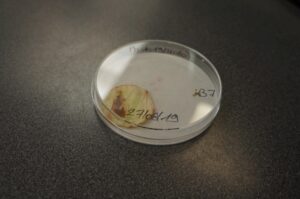
At this production centre, they focus on six species of Nematodes. The petri dishes with slugs and lettuce shows us how they discover which nematodes are capable of killing the host (the slug in this instance). Those are the chosen ones who then go on to be farmed in the fermentation tanks.
Which is where I started my tour.
Nematode Factory Visit
I was and am grateful to the Garden Media Guild, Kate and Puja from Paskett PR for organising the tour. And to Tom and Gavin from BASF for answering my many, many questions with intelligence and humour!
Of course, the visit wasn’t just about educating Garden Media Guild Members. What we learn we’re able to pass onto you, in an informative and entertaining manner. Using nematodes has become an increasing part of our garden pest reduction strategy over the last ten years or so.
I did wonder whether, as nematodes are living creatures, it should be a nematode farm rather than factory. Do you have any preference, or even consider the term used makes a difference?
Nematodes and Your Garden
Nematodes are used as a biological control against pests such as slugs, chafer grub, ants, gooseberry sawfly, leatherjacket, vine weevil and more. BASF’s products will be familiar to you as Nemaslug and Nemasys.
The pot of putty you receive in the post needs to be kept refrigerated until use in the garden. Remember they’re living creatures, held in semi-dormancy, but if you don’t use within the allotted time, they’ll die. And won’t be able to predate on your slugs and sciarid fly.
Used as per instructions they can an excellent resource. I’ve used them to successfully combat gooseberry sawfly and slugs on the allotment. And I know that some of you, my clients and readers, have been pleased with results too.
However, not all nematodes are good nematodes. Some actually harm plants that we as humans grow as food crops. But that is another blog…
Lastly, you may like out check out BASF’s Nematode Factory YouTube video tour, to give you a virtual flavour of nematode soup. Which thankfully was as close as we got – pleased to report there was no soup or halva on the lunch menu!
Perhaps you’d like organic gardening lessons in your own garden to get to grips with pests and more. Because where better to learn about what’s relevant to you as a gardener? Plews Gardening Courses and Lessons are bespoke to you and your garden and combine hands on confidence giving with necessary ‘why we do this’ reasons.
And for organic garden design and planting designs, do please get in touch
Find and follow us on your preferred social media – Instagram Facebook Pinterest for more inspo
Related Gardening articles you may enjoy from our Award Winning Blog
Garden Pests – Snails and Slugs 5 tips for dealing with the molluscs
What is Organic Gardening?
Soil – the plant food in your garden
See also the Garden Pests & Predators and Garden Visits Categories
photo copyright is either Marie Shallcross or BASF (thanks!) Please contact Plews in the first instance regarding re-use


