
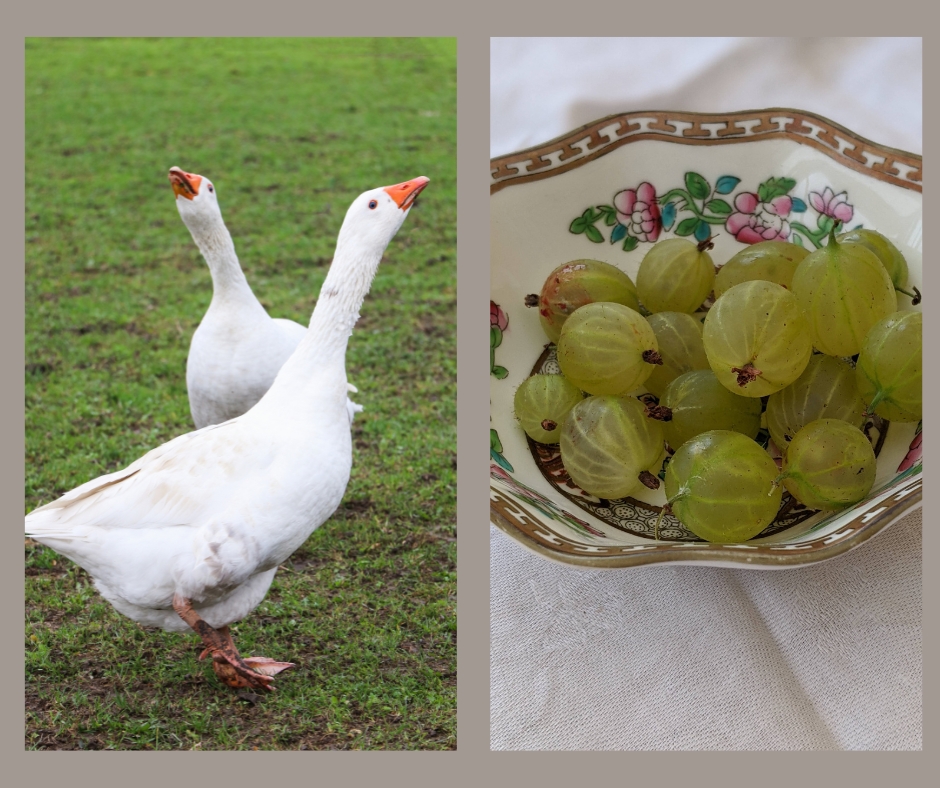
Do Geese eat Gooseberries? and other questions answered by yours truly. Some will entertain, some will educate, but hopefully will encourage you to try eating a homegrown gooseberry and then growing a bush or two in your own garden.
Gooseberries are such a tasty fruit. if you’ve only ever eaten supermarket ones you’re missing a treat! Home grown fruits are sweet and juicy, and the range of varieties you can grow mean you can eat some straight from the bush.
A favourite fruit of mine, I love eating them both freshly picked and in a crumble. They’re also one of the first fruit bushes I remember from early childhood. Cat fur caught on the spiny stems as Charlie the cat chased the blackbirds. And the texture of the hairy fruit, ripe enough to easily be picked; but not all of them edible raw!
But First: What is a Gooseberry?
Sometimes referred to these days as one of the “forgotten fruits” (see below) the gooseberry has long been grown and eaten in Europe.
Native or naturalised across much of Europe and western Asia, the gooseberry has been cultivated for many hundreds of years. These were first mentioned in cultivation in England in 1276, for King Edward I’s garden. They were first mentioned in the wild c 1730 and that population has increased, partly as a result of garden escapees but also form seed distribution via birds.
Botanically, the gooseberry is a member of the genus Ribes, as are currants. There are about 150 different species of Ribes, made up of currants and gooseberries. The fruit bush we know as the European garden gooseberry is Ribes uva-crispa, synonym Ribes grossularia.
It is a many branched woody shrub with spiny stems that dissuade larger animals from damaging the plant and eating the fruit. It’s an effective defensive measure, although it can make fruit picking a delicate operation for humans!
Gooseberry flowers are bell-shaped, usually greenish pink. These develop into ovoid fruits which can be red, yellow or green depending on the variety. The outer skin is slightly hairy, but not to the extent of a Kiwi fruit for example.
Forgotten Fruits
This term refers to gooseberries, Medlar, Quince, Mulberry and heritage varieties of apples, pears and so on. Theres a link for a Quince blog below. I grow a number of forgotten fruits and heritage varieties of vegetables too, so you’ll quite often find them mentioned in Plews blogs.
Where could I grow gooseberries in my garden?
Preferring dappled shade to full sun in the warmer regions of UK, the gooseberry can be grown in a kitchen garden, or as part of an ornamental border. It’s best not planted too close to a path, because of those spines! A sunny open site in your garden is preferable if you live in more northerly areas.
As gooseberries are self-fertile, if you only have room for one plant, you’ll still get fruit. A rich, free draining soil is best. It is possible to grow the bushes in large pots if your soil is poor quality or you have a courtyard garden.
Left unpruned, the gooseberry can be rather straggly in shape. However, it can be trained as a standard fruit bush. This is where a single stem or trunk is grown to approximately 1 metre high. The plant is then allowed to form multiple stems on which fruiting occurs. It is also possible to grow the gooseberry as a cordon, or single stemmed fruit bush. This should be supported against a wall, fence or trellis erected within the border.
In a small garden, growing gooseberries as a trained form could be useful, as it leaves soil space for other plants to be grown beneath the gooseberry. Perennial fruit, for example, strawberries, may be a possible choice. Low growing herbs, such as chives and parsley, could be grown. Companion planting is another possibility, nasturtiums and calendula would both be suitable.

Are gooseberries named after the goose?
What’s in a name? it is most likely that the fruit is not named after the bird. Unlike some other plants such as goosefoot, the common name for Chenopodium, the leaves of the gooseberry do not resemble a goose’s foot.
Some options for the origin of gooseberry as the common name for the fruit are as follows…
Gooseberry is also known as grosberry. This could be a corruption of the French groseille, a generic name for currants and bush berries. The French name groseille a maquereau refers to the delicious combination of oily mackerel with a tart gooseberry sauce (yum).
In Dutch, ‘kruisbes’ translates as ‘bristly berry’ and can refer to the thorny stems as well as the generally hairy fruit. In German and Latin, the curly leaves and hairy elements of the plant feature in the name.
But maybe the gooseberry fruit could indeed be named after goose / geese.
Mature goose, also known as stubble goose, was eaten in the autumn, at Michaelmas, when gooseberries were not in season. Now, although it’s not unreasonable to hazard a guess that preserved gooseberries could have been used to make a sauce to serve with the geese, fresh fruit such as windfall apples, are more likely to have been used.
However, young, fattened geese, goslings, known as green geese, were often eaten in early summer as a delicacy. These were traditionally served with a feaberry sauce, for which there are extant seventeenth century recipes. Feaberry is an old dialect word for gooseberry.

So do geese eat gooseberries?
Yes, and No.
There is some concern on the internet that gooseberries are highly toxic to geese and chickens, due to them containing hydrogen cyanide.
Firstly, lets distinguish between leaves and berries. The berries of Ribes uva-crispa, the gooseberry, are fine. If eaten to excess they are likely to give anyone ’the runs’ and, of course, care should be taken when eating anything which is new to you if you are prone to allergic reactions, are pregnant, etc.
Hydrogen cyanide is found in small quantities in many foods which we quite happily eat – almonds and spinach, for example. The presence of this poison is surprisingly common in young foliage of many plants in the spring, and the gooseberry bush is one of those.
Small quantities of hydrogen cyanide have been shown to help improve respiratory complaints; large quantities will cause respiratory failure and death. Personally, I would advise against anyone, human, bird or mammal eating plant parts they were not sure were edible.
So it may be good practise to keep your domestic, puppies and young children away from the fresh young leaves of gooseberries (and other such plants) if you are concerned that they may do more than nibble a small amount.
Ripe gooseberries are certainly edible. I just wouldn’t waste them on non-humans. Which means netting the bushes once the berries start to ripen to keep the birds – including geese! – off them may be a good idea.
Which gooseberry varieties are best for me?
This one is tricky to answer specifically without seeing your garden! However, some of the questions to ask yourself about the gooseberry itself are: –
- Do I want to cook and / or make jam with the fruit?
- Do I want to eat the fruit raw?
- If the gooseberry bushes are in your ornamental garden, would red or green berries would look better?
- Would a trained bush form give me more space / look more decorative?
Gooseberry varieties may be one of three types: –
- Culinary – for cooking, preserves and wine-making
- Dessert – which can be eaten straight from the bush when ripe
- Dual purpose
Red, yellow and green berries are found in all types.

Where can I see prizewinning Gooseberries?
You can find them among the fruit exhibits at horticultural shows, large and small; village shows and garden society shows. These are general shows with many types of plant exhibited.
Plant specific were especially popular during the nineteenth century and there were hundreds of Horticultural shows across Great Britain and Ireland Europe and the USA.
Although the number of shows dwindled during the twentieth century, particularly due to the effects of the two World Wars. But in the twenty-first century you can still find a handful of specific Gooseberry Shows. The oldest surviving of these is the Egton Bridge Gooseberry Show in North Yorkshire.
and finally
If ‘do geese eat gooseberries?’ has left you with more questions please do get in touch! Whether you need our Garden Consultancy & Advice Visits, a planting rethink or a birthday present such as Plews bespoke Gardening Lessons, where your classroom is actually your own garden we’ll do our best to help.
For further gardening advice and inspiration, check out Plews Potting Shed blogs, including the selection below.
And you could come and find us on Instagram Pinterest Facebook YouTube
Feeling nosey? You can have a peek at the progress of my garden renovation, Spitfires and Slow Worms, on Instagram and Facebook
You’ll get to see it in person if you come to the Plews Gardening Workshops
And why not get your local garden club, allotment, WI, U3A or other group to ask me along to give a talk?
Related Gardening articles you may enjoy from our Award Winning Blog
Growing Gooseberries in Your Garden
Bramley Apple – from chance find to nation’s favourite
Choosing Apple Varieties to Grow in Your Garden or Orchard
Easy Maintenance Edible Gardens
What is an Ornamental Edible Garden?


