

Easy maintenance edible gardens – many people consider that to be a contradiction in terms, but it doesn’t have to be.
Are you one of those who would love to grow your own vegetables, salads and fruit but think it’s too time consuming? Growing your own fruit and vegetables is often thought to be difficult as well as needing lots of work by novice gardeners in particular.
Yes, some fruit and vegetables are trickier to grow, or have special requirements. But there are so many which are easy to grow and, more to the point, do not takes hours every day to look after.
At Plews we’ve had the pleasure of creating easy maintenance edible gardens for lovely clients who wanted to grow their own lunch. And I have given many gardening lessons to show that growing your own fruit and vegetables doesn’t need to be time consuming, or a chore.
There are some basics that you’ll need to get sorted, so I thought that sharing a few tips for how to start your own easy maintenance edible garden might be helpful.
Easy maintenance edible gardens – decide what and where to grow
It isn’t critical which of these questions you answer first, as they’re all interlinked. For example: –
You decide you want to grow salad greens / lettuce and heirloom varieties of tomatoes. You have a courtyard garden so they’ll need to be grown in containers.
Consider how the plants grow. The salad greens will be shallow rooted as you want to pick them fairly small. Whereas the tomatoes will need more soil depth and support, as they’re unlikely to be compact plants.
By growing the lettuce where they only get the morning sun they’ll need less water. For the tomatoes you could use a home made watering system (see tips below) as they’d prefer more sun.

When
Decide how much time will you realistically have or want to spend tending your veggies, fruit and salads. Some crops need small amounts of regular time, others need more sporadic attention at particular times in the growing season.
Even some regular tasks can be reduced. For example, there are ways to lesson the time you spend watering; perhaps by using some form of irrigation or by choosing plants which need less watering in the first place.
Choosing crops which need daily irrigation, twice daily at certain times in their growth and when its, hot then growing them on an allotment which is a 30 minute cycle ride each away may not be the best use of your time…

What
What do you like to eat? To begin with, think of the more interesting foods, like asparagus or early rhubarb rather than ordinary potatoes. Make a list. Be as specific as you like, for example, Bramley cooking apples rather than apples; yellow plum cherry tomatoes; rainbow chard.
Now you have your list of foods, which will grow in this country? Will you need covered growing conditions like a greenhouse? This can still be easy maintenance, but you need to be sure you have the necessary tools and environment if you want an easy life.
Where
Are you able to grow your own in your garden? Or will you need to borrow someone else’s garden? Or lease an allotment? There are various schemes for garden share, both local and national. Whilst its not possible to grow all the fruit and veg for a family of four on a small balcony, there are still interesting crops you can successfully cultivate in a small space.
What is your budget? A few fruit bushes won’t cost much but if you really need automated watering systems to cover a kitchen garden, then you’re looking at a larger budget.
And lastly, if you’re new to gardening, or to growing edible crops, start off small, keep it simple.
Easy maintenance edible gardens – two “case studies”
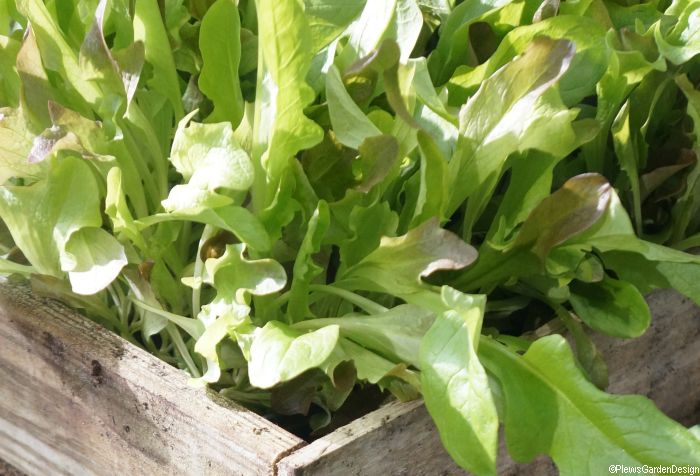
Cut and come again salad leaves
Growing a pot of salad rocket or oak leaf lettuce seedlings, which you then prick out into a suitable container and keep near the back door is easy maintenance.
They can be grown in quite shallow trays as they’re continually picked. Put this into a gravel tray so you don’t need to water every day. Kept by the back door they’ll be convenient to pick and water. Pick the outer leaves so new ones can grow from the centre.
Sow seeds in a fresh tray on a fortnightly basis to ensure a continuous crop. And if you can provide shelter you should be able to grow a year round supply.
Blueberries
Are you a fan of blueberries? These tasty fruit can be expensive to buy but grow well in a designated fruit garden, the flower border if you have an acid soil or a container.
Make the compost growing media both water retentive and free draining. Use a peat free ericaceous organic compost, or one which uses “sieved” peat where it has been sourced from lakes and rivers, not peat bogs. Blueberries need an acid soil pH5.5 or thereabouts.
A large container or raised bed in which you can grow five blueberry bushes that fruit early – ‘Duke’ (good in short growing season areas); mid-season – ‘Patriot’ (good on heavy wet soils); and late season – ‘sunshine blue’. These or similar will give you a long season of fruit and be easy to water manually. And you generally only need to prune them once a year. If you plant some annual flowers around them you’ll improve pollination (although some blueberries are self-fertile) and reduce pests and diseases. Calendula is a good choice as an annual companion plant as it self-seeds easily; and the petals make a colourful addition to salads!

Perennial fruit and vegetables generally make for easy maintenance edible gardens.
A case of plant once and then you’re sorted…or nearly.
Perennial Fruit
There is a wealth of perennial fruit to choose from! indeed it always surprises me that short-of-time gardeners don’t grow more. They include fruit bushes, soft fruit, top fruit and vining fruits.
Fruit bushes and soft fruit
- Blackberries
- Blackcurrants
- Blueberries
- Cranberries
- Gooseberries
- Loganberries
- Raspberries
- Redcurrants
- Strawberries

Top fruits
- Apples, cookers and eaters
- Cherries
- Greengage
- Medlar
- Pears
- Plums
- Quince
There are other fruits, such as citrus, apricots, goji berries, kiwi, which can still be classed as easy maintenance but may need extra attention.
Rhubarb is strictly speaking a vegetable, although we treat it as a fruit when we come to eat it.
Perennial Vegetables
These could include –
- Asparagus
- Cardoon
- Globe artichoke
- Jerusalem artichoke
- Perpetual spinach
- Swiss chard
- Welsh onions
Even if they’re not all exactly perennial, they do crop for more than just one season, which means you’re not sowing seeds every year.
Perennial salads for easy maintenance edible gardens would include Salad burnet (Sanguisorbia minor), Sorrel (Rumex acetosa) and Good King Henry (Chenopodium bonus henricus)

Annual Vegetables and Salads
But for those of us who love our mange tout there have to be some annual vegetables. There are still ways of making annual fruit and vegetables easy maintenance.
If you have little time and little space, buying trays of seedlings rather than sowing for seed is one way. You’ll need to prick them out into larger pots, grow them on for a while and probably harden them off unless you buy late in the season. But it is still less time consuming.
Tomatoes and courgettes can be bought as small individual plants and grown on at home. As they produce many fruit to one plant this is still cost effective.
However, the main bug bear for making your edible garden easy maintenance is probably the watering issue.
Easy maintenance edible gardens – watering
When you water, water well at the root level. Rather than using a watering can with a rose attachment on the spout, why not make your own reservoir?
This is easily done by re-purposing a plastic drinks bottle. You can have individual reservoirs for larger plants, such as tomatoes or courgettes. Or, group your vegetable plants – peas for example – in a circle around a bottle when you plant them in the ground or raised bed.
Adding the reservoir is best done at planting time so as not to disturb the plant’s roots.
- Take the cap off the bottle and spike a few holes in it so that the water filters through. Replace.
- Slice off the bottom of the bottle.
- Dig a hole for the bottle and put it cap end down into the ground.
- The top edge of the bottle needs to be higher than the soil level but how much sticks out is your choice. Just be sure that foxes/ cats/ helpful children are not able to knock the bottle over or pull it out.
Then all you need to do is fill with water and your plant will enjoy a drink at root level. Top up when nearly empty. For young fruit trees, you could use multiple bottles. Yes, you’ll still need to fill them up, but when it rains, your reservoir will fill itself!

And finally…
Hopefully the above tips and ideas have given you a ‘taste’ of how easy maintenance edible gardens could work for you. There are other tips and tricks, some of which can be found in other Plews Potting Shed blogs, including the selection below, our monthly Tipsheet and regularly on Instagram and Facebook
Making your life easier and enabling you to enjoy your garden is part of what we discuss when we come to design your garden and give gardening lessons in your garden.
Related Gardening articles you may enjoy from our Award Winning Blog
Grow your own vegetables in rows
What is Square Foot Gardening?
Lasagna Gardening – Growing Methods for Gardeners
How to use the Three Sisters Cultivation Method
Crop Rotation – Growing Methods for Gardeners
Tomato Tasting – 5 Varieties to Grow in Pots
How to Choose Apple Varieties to Grow in Your Garden or Orchard
How to have a Mini Orchard in Your Garden
Growing acid loving Fruits
Bare Root Fruit Bushes
Growing Gooseberries in Your Garden
So What Might a Plews Gardening Lesson Be Like?
Allotments and Allotment Gardens
Raised Garden Beds in the Vegetable Garden
Choosing Your Greenhouse


