Summertime: why not celebrate with a drink? These 17 herbs for summer drinks will suit you nicely whether you’re after something to spice up your cocktails, add piquancy to non-alcoholic drinks or even flavour that jug of water on the dining table.
Do you think 17 sounds an awful lots of herbs? Well, maybe, but it’s not the full list that I thought of! Hopefully, I’ve included some herbs you may already have growing in your pots and garden borders but hadn’t realised you could use in this way. And are also introducing you to new herbs to grow and eat.😊
The focus may be on herb flavours, but there are cultivation tips and anecdotes too. I’ve included the Botanical Latin name so you can be sure you’re buying the correct herb. And you’ll find links at the end to Plews blogs on herbs and herb gardens.
How strong or true are the flavours in these 17 herbs for summer drinks?
The plant type, or species, of herb, i espearmint or peppermint, will give you the primary flavour, whilst the cultivar or variety gives you the secondary flavour. The strength of flavour will depend on the individual person as well as the herb itself. This is because how we perceive taste depends on a variety of factors, including both our taste receptors and personal, previous experience.
For example, to me, Strawberry Mint tastes softly rather than strongly of mint, with an overlay of strawberries. But some friends just get a general fruitiness woven in to the mint scent.
If you ‘re heading out to purchase some of these suggested herbs, then, if possible, at least smell before you buy.
If you have permission, rubbing the leaf and sniffing will give you an idea of the strength of the flavour. Nibbling the leaf so it’s on your tongue will give you a truer taste.
Buying the herbs on line makes smelling somewhat tricky, so if you’re able to, visit a friend’s house or a herb garden before hitting the pay now button. And if you hate the herb smell when it arrives, do swops with a gardening friend or donate to a charity plant sale. 😊

General note on using the herbs
Although the leaves are usually still flavoursome once the plant flowers, to enjoy the best taste, it’s advisable to remove the flowers before they bloom. This seems a shame, both for their prettiness and as a pollinator food source.
An ideal solution which takes up little garden space, is to grow two plants (or more) of each of your choices from the list of 17 herbs for summer drinks. That way you can harvest leaves from one plant whilst the bees, hoverflies and butterflies enjoy pollen from the other. And of course you’ll be able to collect seed from the flowering plants to sow for the following years crop. (if you want to, it’s not compulsory!)

Mint
Just about all the Mentha, or Mint, species spread with great enthusiasm, so its best to grow them in pots, tubs, raised beds or a separate border. They are herbaceous perennials, dying back to ground level overwinter. Generally, they like morning sun and then some shade from the hot summer sun.
Depending on the cultivar, and where in the UK you garden, mint plants flower between late May and early September.
Blackcurrant mint
Mentha spicata ‘Blackcurrant’, has a blackcurrant / spearmint flavour, attractive dark red stems and dark lilac flowers. As well as being delicious in drinks, Blackcurrant mint is good in both sweet and savoury dishes.

Grapefruit Mint
Mentha x piperata f. citrata grapefruit is the one is for you if you love a grapefruit for breakfast! It has green foliage and purple flowers. If adding to dishes, use sparingly at first as it can be quite strongly flavoured.

Hemingway’s Mojito Mint
According to legend, Ernest Hemingway’s favourite drink was the Mojito, which he drank often at La Bodeguita del Medio, in Havana, Cuba. And this is the variety of mint that was purportedly used by the bar to make those Mojitos.
Mentha spicata ‘Hemingway Mojito’ tastes of spearmint not Mojito (!) but I love it for the story anyway. It has pretty pink flowers and can be used as a culinary herb in place of ‘ordinary’ spearmint.


Hillary’s Sweet Lemon Mint
Another mint with a tale, Mentha ‘Hillary’s Sweet Lemon’, syn Mentha dulcia citreus, is named for Hillary Clinton. It was bred by Jim Westerfield, an Illinois plantsman who bred dozens of new varieties. Hillary is bred from a cross between apple and lime mints. It has a light lemony-mint flavour that is particularly good in cool drinks and salads. The plant itself is attractive with soft grey toned foliage and mauve flowers.

Strawberry Mint
Mentha × piperita ‘Strawberry has a distinct strawberry fragrance and flavour. One of the more delicate looking mints, it has small, aromatic, mid-green leaves and pale purple flowers.

Basil
A stalwart of many a summer garden, the majority of Basil cultivars are annuals, although some are short lived tender perennials. Ocimum basilicum is sweet basil, the one most of us would instantly recognise as basil, these two look slightly different.
Lemon Basil
Ocimum x citriodorum, syn Ocimum x africanum ‘Lemon Basil’. There is also a heritage cultivar, Ocimum basilicum Mrs Burns’ ‘Lemon Basil’, which has a more intense citrus flavour, which if kept frost free, ought to survive as a tender perennial.
This basil has slim, bright yellow–green leaves that have a strong citrus-basil flavour and scent that I find quite delicious! The small white flowers produce seeds that are also lemon scented.

Lime Basil
Ocimum x africanum ‘Lime’, syn Ocimum basilicum ‘Lime’, has small, oval, bright green leaves and white flowers. The zesty flavour from the combination of lime and basil scents works well in tonic-based drinks.

Balm
The name Melissa means ‘honeybee’ in Greek, and refers to the small, white, nectar rich flowers. Balm likes a sunny spot, but will self-seed and produce new plants that you’ll find growing in shady spots. Be vigilant and cut off those flowerheads as soon as they go over!
Lemon Balm
Melissa officinalis is most likely the balm you’ve come across before – and may well have in your own garden. Pick the young leaves to use in drinks as being the best flavour and softest should they slip into your glass and you accidentally eat one.

Lime Balm
The leaves of Melissa officinalis ‘Altissima’ will give you a citrus flavour without the sharpness of the fruit. Perversely, I like to add a few leaves to a lime and soda, but it also tastes good added to cocktails where a stronger flavour might affect the balance.
Growing-wise, I’ve found lime balm to be less hardy and more needful of a free draining non-chalky soil than lemon balm.

Sage
Salvia is the Latin name for both edible and ornamental sage plants. There are shrubby perennial, herbaceous perennial and annual types; many are hardy throughout most of Great Britain.
Blackcurrant Sage
Whilst most of the Salvia microphylla types have a blackcurranty undertone, it’s Salvia microphylla var. microphylla that has the nose-arresting aroma. I haven’t yet found anyone who is not able to smell the rich fruity fragrance of these leaves (there will be, perhaps it’s you, let me know 😊).
The leaves add a lovely twist to cool drinks and the deep pink flowers attract pollinators. I bought a blackcurrant sage in 1997, so it was one of the recently introduced ones and I have a cutting of it growing in my current garden. Indeed, that blackcurrant sage purchase was when I fell in love with Salvias.
Hardy in much of the UK, if you have a windy garden or heavy clay soil, I suggest you take cuttings.

Pineapple sage
Salvia elegans, Salvia splendens, is a stunning garden plant with bright tubular red flowers and pineapple scented foliage. A great way to ‘zing up’ that jug of water on the table, I like it paired with one of the lemon scented herbs.

Tangerine Sage
Salvia elegans ‘Tangerine’ looks similar to pineapple sage, but has a light brown edge to the leaves.
Both pineapple sage and tangerine sage are tender perennials. They may be fine in a warm sheltered spot, but I’ve always taken cuttings or grown in a pot and taken under cover for winter. Alternatively, treat as summer bedding and buy new plants each year as both are pretty easy to find in nurseries, garden centres and online.

Thyme
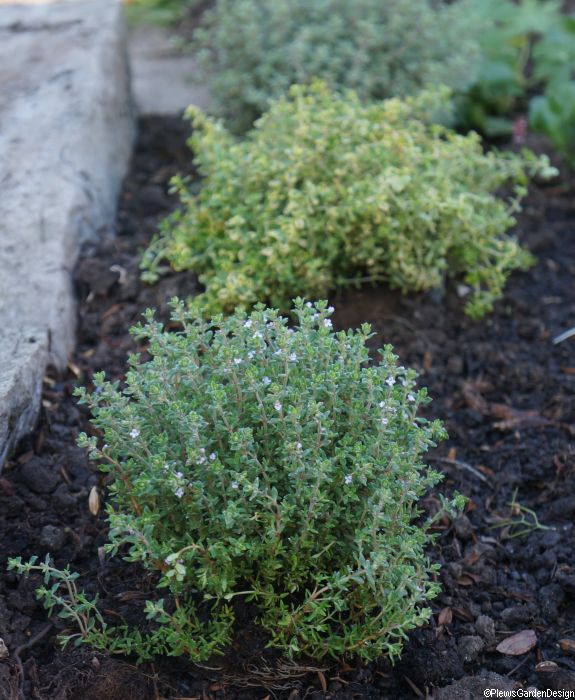
The slightly smoky, woody aroma I love about common Thyme has a delectable citrus overlay in these plants.
Lemon Thyme
Thymus citriodorus, syn Thymus ‘Culinary Lemon’, has small dark green leaves and pale purple flowers. There’s also Thymus ‘Mystic’ with variegated foliage.

Orange Thyme
Thymus ‘Fragrantissimus’, syn Thymus citriodorus ‘Fragrantissimus’, has orange scented grey green foliage and pinky-mauve flowers.

Only three more to go in our list of 17 herbs for summer drinks!
Interestingly, the first two of these are the only herbs we’ve looked at that are not members of the Lamiaceae, or Mint, family. It is a plant family containing a high number of edible plants, so perhaps it’s not that surprising.
Lemon Verbena
An attractive shrub for a sunny sheltered spot, Aloysia citrodora, has, to my nose, the most evocative lemon fragrance outside a lemon grove in southern Italy in summer.
Lemon Verbena is tender in many areas of the UK, and even in warmer gardens until it’s established. I tend to take cuttings anyway, just in case. You could grow it in a pot and bring it into a cool conservatory over winter (and then enjoy brushing the leaves to release that lemon perfume).
Try lemon verbena leaves in a homemade lemonade for a new twist on a favourite taste. It makes a refreshing infusion on its own too.

Salad Burnet
Sanguisorba minor, syn Poterium sanguisorba is a perennial herb with leaves that have a mild cucumber taste. It’s been naturalised in Britain since the 16th century, but I don’t feel it’s as commonly known as it should be. Salad Burnetcan be nibbled raw whilst you’re weeding, added to summer drinks and salads, even chopped into mayonnaise for a fresh flavour.

Mexican Hyssop ‘Sangria’
Yes, I chose this one largely for its name! But Agastache mexicana ‘Sangria’ does have lemon scented leaves and pink flowers. As with all of these herbs in this blog, the flowers as well as the leaves are edible. This is one of the tallest of my choices, quickly reaching 3’-4’ tall. An herbaceous perennial, it may be tender depending on where you garden. Cuttings are easy to take through spring and summer.


Picking the herbs for winter use
Leaves on all of the 17 herbs for summer drinks above can be picked and stored. If you want to continue using them in cool drinks, then it’s best to freeze them. Collect pest and disease free younger leaves, preferably in the morning before their essential oils are released by the heat of the day. Freeze in water in ice cube trays or open freeze. Personally, I’ve found less discolouration occurs when freezing in ice cube trays.

and finally
Whether you grow and use any or all of these 17 herbs for summer drinks or have just read the blog for pleasure, I hope you have fun and enjoy your garden. And if Plews can help you with anything, please do get in touch. For example –
If you’d like help creating a herb planting design for your garden, or have queries regarding your existing garden, do get in touch to ask about our design and consultancy services.
But if you’d prefer hands-on personal help from yours truly, with a mix of practical sessions and theory, perhaps our bespoke Gardening Lessons and Courses would suit you? These are where your classroom is actually your own garden! For example, you could learn how to design, plant and grow your own herb garden. Have a read through this pdf download for info.
For further gardening advice and inspiration, check out Plews Potting Shed blogs, including the selection below. You could come and find us on Instagram Pinterest and Facebook for more ideas and tips. The monthly Tipsheet is being revamped but will be back soon.
Feeling nosey? You can have a peek at the progress of my garden renovation, Spitfires and Slow Worms, on Instagram and Facebook
You’ll get to see it in person if you come to the Plews Gardening Workshops
Plus get your local garden club, allotment, WI, U3A or other group to ask me along to give a talk (and bring plants 😉)
Related Gardening Blogs from the Award Winning Plews Potting Shed
How Many Types of Basil Plant are There?