

What does an overgrown garden have in common with an onion? Peeling back layers to find that there are yet more layers is what I’m feeling is the common factor. Don’t get me wrong, I find it a good thing! And unlike the onion, the garden gets bigger not smaller as it reveals itself. Which is definitely true of this garden, as when I say overgrown, I mean laurel hedges that extend some eight foot into the garden as well as being twelve foot high.
And this was the situation in my (our!) new garden. When we first saw the property on a sunny June afternoon it was obviously neglected (the house too) but that didn’t stop us from falling in love at first sight.

I knew it would be a long slog but could see the possibilities both for restoring the garden and adding my own personality. Despite much desecration and decay there were remnants of a formal garden, water garden, kitchen garden. All set into a southerly facing hillside.
We couldn’t see the boundaries to the sides or rear. No, seriously! The ground dips and the lowest part of the garden was, and is still currently, inaccessible. But I started working our a 3 year plan for clearance and renovation as the sale progressed.
Fast forward about a couple of years to when we were actually able to move in. (I’ll regale you with the whole saga another time – you couldn’t make it up!)

A note about the photos
Whilst the short videos are mine, the photos are all by Julie – taken on the first of what will be many visits. Recording the garden as it changes is very important, part of its history. And of course an aide memoir along with my notes for what grows well and what doesn’t! Another person’s perspective is always useful and I love that Julie also sees my challenge with an explorer’s eye.
A taster for you a day or so after we moved in

In the beginning- an overgrown garden or a secret garden?
We were greeted with knee high grass, swathes of brambles over 5 foot tall, a privet hedge that scratched the sides of our vehicles as we reversed down the drive and about two 8 yard skips worth of rubbish left behind by the previous occupants and owner on the top lawn and around the property. Valerian (Centranthus rubra) hung over the walls in a nodding mix of pale pink and red flowers filling up spaces left by the ivy. Yellow flag iris filled the ponds leaving little room for water lily pads.
The top part of the garden is fairly level but most of garden is terraced and meanders down a southerly facing hill. More than half of the paths and flights of stairs were impassable. Although I have yet to find photographs of the lowest part of the garden, thanks to the internet I have found some archived material that help in working out where some structures might be. For the rest, we scramble through dense vegetation, usually of the thorny type, to discover hidden secrets.


Progress, but slowly
Because sometimes the house issues had to have a higher priority. Leaking shower and radiators, replacing render on the house wall, scaffolding, gutters, blocked drains …
Visit number one from the tree surgeons (they’re due again soon). And a welcome reduction by half of the 40 foot Leylandii. Because of their size and position – right next to a supporting wall – the removal will be done in three stages to reduce the impact on the soil and surroundings.
Ponds – we knew there were two ponds, one in a sunken garden with a statue called the shady lady as she was swamped by very tall yellow flag iris. The other, lower and larger pond, is the fish pond. Against incredible odds and no feeding for who knows how many years there were still fish in the pond. They now come swimming towards us when they feel the vibration oi footsteps on the stairs, hoping its teatime.
I’d also spotted a ‘spitty lion’ higher up the garden, next to the path underneath the summerhouse, and guessed there was some sort of pond below it for the water to flow into. But there were too many brambles to see for sure. There is a pond and more besides. That sort of rockery area is also where the glorious acer resides.
What we didn’t know was how many ponds we would find once we started to clear shrubs, brambles, ash saplings and more. We’ve found a total of ten including those mentioned above. Mainly small ones and following the lie of the land they are a wonderful feature – or will be!


Apple trees
You can read about some of the exciting discoveries we made in the cordon apple trees blog link below.
But there are two other old apple trees, probably Bramley cooking apples. One of them is fairly upright. The other fell forwards when the supporting hen house and run were taken away before we moved in. But it is still alive despite being pretty much horizontal and has fruited too. To the extent that the spare room is doing duty as an apple store this year.
The old kitchen garden forms part of this area, but on the opposite side. This area, covered with nettles, brambles, buddleia, hazel is on the list for clearing in winter 2022 – 23. I plan a fruit cage and some of those ash and hazel stems we’ve pruned will provide support for runner beans and sweet peas.
There are two other apple trees in the garden. These are in pots and form part of the truck load of plants I brought with me. There’s also a medlar, an olive, rhubarb, blackcurrant bush, raspberries and strawberries and lots of herbs. (That’s just the perennial edible group). Other of my apple trees will be dug up from a friend’s garden this dormant season.


The lowest part of the garden
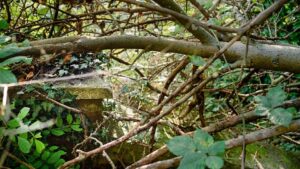
This really is an overgrown garden – but also magical. We’ve scrambled under and through small sections with secateurs and loppers (and many an ouch and a curse!) We have found deer and pheasant tracks on a snowy day; slow worms and hummingbird moths on a sunny afternoon.
But we are trying hard to resist the enticement of the formal stairs with their round post finials. At least until we have made a little bit more of the garden dog proof. With a Border Collie, an indoor clothes drying rack will act as a fence once she’s been told that’s what it is. But that doesn’t prevent her from following our tortoiseshell cat through one of the more-gaps-than-hedge sections, of which there are many.
The first three months
I freely admit we got behind schedule for various reasons. Not least, having to be away for work and family matters; rock hard soil that made digging out shrubs difficult and the extremes of heat and rain. But it was still a time of discovery. In such an overgrown garden, even a simple gardening task like deadheading can lead to a couple of hours of clearance where there might be wild orchids or a rose bush to uncover.
But a slow pace is fine. It gives me time to learn how the weather affects the garden, where gets the sun all day and how bright that light can be, almost Mediterranean. Yes, there are some tasks that have a seasonal or practical imperative. But there is always time to stand still and watch the buzzards and the dragonflies.

Julie’s comments on my overgrown garden
Gardens that have fallen into neglect have long fascinated me – once much-loved green retreats, reclaimed by brambles and nettles. Every once in a while, their mystery entices in a passionate gardener. Then the lucky places (for example, Heligan in Cornwall, Lowther in Cumbria) begin a project of restoration, revealing secrets along the way.
This is why I find Marie’s garden project so fascinating. Yes, there are years’ worth of work to be done. Plants, trees and seedlings have established themselves in every spare corner and paving crack. There’s certainly a half-hidden system of ponds and waterfalls. There are levels, walls, stairs and balustrades that can’t fully be appreciated while overgrown. The original owner had thought carefully about designing a hillside garden on several levels, adding clever features not just to deal with the gradients, but to get the most out of them. I like that Marie has a vision for the garden; while at the same time, allowing herself to be respectful and open to original design features that might yet reveal themselves.
I could have spent many more hours exploring the garden as the light fell in different corners. The big kid in me enjoyed being able to clamber into different corners and navigate tricky sections of wobbly path, all the while with so much to observe. I felt very nostalgic about the top pond that reminded me of the Blue Peter Italian Sunken Garden! The Acer as you approach the house – visible from many of the windows – was one of my favourite features, complementing the green woodland beyond. The curving sweep of the lower staircase drew me in: such classic elegance. But most of all, this is a garden of multiple textures, contrasts and forms, already pleasing to the senses but offering so much more to come.

And finally
Well, it’s not so much a finally as I’ll keep you updated on other aspects of our overgrown garden and its renovation over the next three years or so. With plenty more photos from Julie too. She is a professional garden and food photographer, a fellow Member of the Garden Media Guild, which is how we met. Julie is a Member of the Professional Garden Photographers Association and you can find out more at her website https://julieskelton.com .
As for the history of this house and overgrown garden, I am on the trail of finding out as much as I can about them. Luckily some of the neighbours and their families have been here a while and have anecdotes to share. Other research also tells me that there was an orchard nearby which belonged to the estate that, when sold in the first years of the 20th century, provided individual plots of land one of which is this one.
Although its actually a bit more complex than that. A few of the plots were sold as larger ones but ours would seem to be one of the standard size plots, or rather our overgrown garden and the house that sits in it make up a six plot site, with all the plots bought at the same time. Later, a further two plots were bought from a neighbour so the garden widens at the lower end.
For further gardening advice and inspiration, check out Plews Potting Shed blogs, including the selection below and our monthly Tipsheet – You could come and find us on Instagram Pinterest and Facebook too.
oh and keep scrolling down for more video and photos
Related Gardening articles you may enjoy from our Award Winning Blog
How To Renovate Your Garden, Part 1
Cordon Apple Trees – Garden Surprises when Pruning
Is Ivy Weed or Wildlife Habitat?
How to Puppy Proof Your Garden
Wild about Gardens – Design Ideas for Humans and Wildlife


Renovating a garden is a long and winding road with many detours. An overall plan is essential, but flexibility and a willingness to acknowledge and work with the seasons and the garden as well as one’s dreams is key to success. The journey is just as important as the end result. Perhaps more so, because after all, a garden is never ‘finished’.


